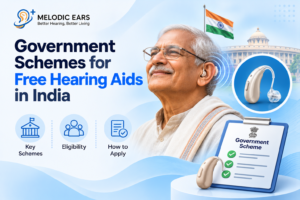
Senior citizens in India can obtain free hearing aids primarily through two central government initiatives: the Rashtriya Vayoshri Yojana (RVY) and the ADIP Scheme (Assistance to Disabled Persons for Purchase/Fitting of Aids and Appliances). Both schemes are run by the Ministry of Social Justice and Empowerment and implemented on the ground by the Artificial Limbs Manufacturing Corporation of India (ALIMCO), district hospitals, and local social welfare departments.
This guide explains who qualifies, which documents you need, the exact steps to apply, and what types of hearing devices the government provides.
Main Government Schemes for Free Hearing Aids
The central government operates two separate programs that provide free hearing aids to older adults. The right scheme for you depends on whether you hold a disability certificate or qualify under senior citizen welfare criteria.
1. Rashtriya Vayoshri Yojana (RVY)
The Ministry of Social Justice and Empowerment launched the Rashtriya Vayoshri Yojana specifically for senior citizens facing age-related physical disabilities, including sensory loss such as presbycusis (age-related hearing loss). Under this scheme, devices are distributed free of cost to eligible older adults.
- Target group: Senior citizens aged 60 and above.
- Economic criteria: Applicants must belong to the Below Poverty Line (BPL) category or have a monthly family income not exceeding ₹15,000 (limits can vary slightly depending on state welfare revisions).
- Disability certificate: A formal 40% disability certificate is not always mandatory for RVY camps if a certified government medical officer or audiologist at the assessment camp diagnoses age-related hearing impairment.
Also Read- Hearing Aid Price List India 2026 – ₹5,000 to ₹3,00,000 Options
2. ADIP Scheme (Assistance to Disabled Persons)
The ADIP Scheme is open to disabled individuals of all ages, including senior citizens. If an older adult has a permanent hearing impairment of 40% or more, they can apply for assistive aids under this program.
- Target group: Any person with a benchmark disability of 40% or higher.
- Income limits:
- 100% subsidy (Free): Monthly income up to ₹22,500.
- 50% subsidy: Monthly income between ₹22,501 and ₹30,000.
- Replacement frequency: Beneficiaries can receive a replacement hearing aid once every three years (or after two years in the case of children).
Comparison of RVY and ADIP Schemes
| Feature | Rashtriya Vayoshri Yojana (RVY) | ADIP Scheme |
|---|---|---|
| Primary Target | Senior citizens (60+ years) | Persons with disabilities (all ages) |
| Disability Requirement | Age-related loss assessed at government camps | Minimum 40% certified hearing disability |
| Income Limit | BPL category or family income under ₹15,000/month | Full subsidy up to ₹22,500/month; 50% up to ₹30,000/month |
| UDID Card Mandatory? | No, but recommended | Yes, or a state medical board disability certificate |
| Implementation Agency | ALIMCO / District Administration | ALIMCO / DDRCs / Designated NGOs |
What Kind of Hearing Aids Does the Government Provide?
The devices supplied under government welfare programs are produced or procured through ALIMCO. In the past, programs distributed analog pocket-model body-worn aids with cords. Currently, the standard offering has been updated:
- Digital Behind-the-Ear (BTE) aids: Most recipients receive programmable or semi-digital BTE devices. These rest behind the ear and connect to an earpiece through thin plastic tubing.
- Battery provision: Distribution kits usually include an initial supply of hearing aid batteries and a cleaning tool. After these run out, recipients must purchase replacement zinc-air batteries themselves.
- Fit and customisation: Basic amplification levels are adjusted by ALIMCO technicians or camp audiologists based on pure-tone audiometry results.
Government schemes do not provide invisible-in-the-canal (IIC), completely-in-canal (CIC), or high-end Bluetooth rechargeable hearing aids. Beneficiaries seeking custom aesthetic shells or wireless streaming features need to purchase those independently from private hearing clinics.
Documents Required to Apply
To avoid delays during assessment camps or hospital visits, carry original copies along with two sets of self-attested photocopies of the following documents:
- Proof of Age: Aadhaar card, Voter ID card, passport, or school leaving certificate establishing that the applicant is at least 60 years old.
- Proof of Identification and Residence: Aadhaar card, ration card, or utility bill.
- Proof of Income: BPL Ration Card, certificate issued by a Revenue Officer (Tehsildar), or an official pension slip.
- Disability Certificate / UDID Card: For the ADIP scheme, a certificate from a government ENT specialist showing 40% or more hearing impairment. (For RVY, assessment often occurs directly at the screening camp).
- Audiogram (Hearing Test Report): A recent pure tone audiometry report signed by a registered government audiologist, if you already have one.
- Passport-Sized Photographs: 4 recent passport-size photographs showing the ears clearly.
Step-by-Step Application Process
Step 1: Get an Audiological Evaluation
Visit the ENT department of the nearest Civil Hospital, District Hospital, or government medical college. An audiologist will conduct a pure tone audiometry (PTA) test inside a sound-treated booth. This establishes the degree of hearing loss in decibels (dB) for both ears.
Step 2: Obtain a Disability Certificate or UDID (for ADIP applicants)
If you are applying through the ADIP scheme, apply for a Unique Disability ID (UDID) via the central government portal (swavlambancard.gov.in) or visit the District Medical Board. The board evaluates your audiogram and issues the formal certificate indicating the percentage of impairment.
Step 3: Track and Attend Local Assessment Camps
ALIMCO, in coordination with the District Social Welfare Office and District Disability Rehabilitation Centres (DDRCs), regularly organizes free assessment and identification camps across rural and urban districts.
- Notices for these camps are published in local vernacular newspapers.
- You can check upcoming schedules by visiting your local Panchayat office, Block Development Office (BDO), or the District Magistrate’s social welfare desk.
- Attend the assessment camp with the applicant present; doctors will verify identity documents and measure the ear canal.
Step 4: Device Distribution Day
Once ALIMCO processes the camp applications, a second camp—the Distribution Camp—is scheduled, usually within 30 to 90 days. Beneficiaries receive the hearing aid, custom ear-mould fitting, basic handling orientation, and warranty documents.
Other Schemes for Working and Retired Government Employees
Senior citizens who do not meet BPL or lower-income thresholds, but are retired government employees, have separate access to hearing aid reimbursements:
- Central Government Health Scheme (CGHS): CGHS beneficiaries can claim reimbursement for digital hearing aids based on recommendations from a CGHS/government ENT specialist. Reimbursement ceilings are set by the Ministry of Health and Family Welfare (typically up to ₹10,000 for a single ear or ₹20,000 for bilateral fitting for basic models, with specific reimbursement codes for programmable digital devices).
- Ex-Servicemen Contributory Health Scheme (ECHS): Retired defence personnel and their spouses can receive digital hearing aids through designated military hospitals or empanelled centres upon specialist prescription.
Also Read- German Hearing Aid vs Indian Brands – Price, Quality, After-Sales
Frequently Asked Questions
Can a senior citizen get a free hearing aid without a BPL card?
Yes. If you apply under the ADIP Scheme rather than the Rashtriya Vayoshri Yojana, you do not need a BPL card. However, your monthly personal or family income must be under ₹22,500 to receive a 100% subsidy, supported by an income certificate from a local revenue authority (such as a Tehsildar).
Does Ayushman Bharat (PM-JAY) cover hearing aids?
Ayushman Bharat PM-JAY focuses primarily on secondary and tertiary hospitalisation expenses, including ENT surgeries such as tympanoplasty, stapedectomy, or cochlear implants for eligible young children. It does not generally cover the direct retail purchase or outpatient dispensing of external hearing aids for age-related hearing loss.
Are the batteries for government-supplied hearing aids free forever?
No. ALIMCO typically supplies the device with a small starter pack of batteries. After using the initial supply, the recipient must purchase standard button cells (zinc-air batteries, typically sizes 13 or 675) from local medical stores or hearing clinics.
What should you do if the free hearing aid breaks?
ALIMCO devices come with a standard limited repair warranty. If the device stops functioning, contact your District Disability Rehabilitation Centre (DDRC) or attend a follow-up ALIMCO camp in your district. Local private clinics can also repair standard BTE tubing or replace ear tips for a nominal service fee.
Can one person receive two hearing aids for both ears?
Yes, if the examining government audiologist documents bilateral hearing loss and specifically prescribes a bilateral fitting. Both the ADIP and RVY schemes permit the issue of two hearing aids when medically necessary for functional communication.