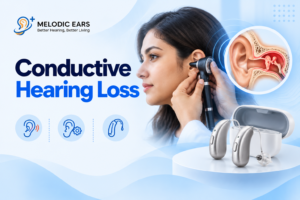
Conductive hearing loss occurs when sound waves cannot travel efficiently through the outer ear canal, eardrum, or middle ear bones to reach the inner ear. Unlike nerve-related damage, the inner ear and hearing nerve usually remain healthy. Hearing aids help by either amplifying sound loud enough to bypass the mechanical blockage or by sending vibrations directly to the inner ear through the skull bones.
How Conductive Hearing Loss Happens
To understand conductive hearing loss, consider how sound normally moves through the ear. Sound waves enter the ear canal and strike the eardrum (tympanic membrane). The eardrum vibrates, moving three tiny bones in the middle ear: the malleus, incus, and stapes (the ossicular chain). These bones transfer the vibrations to the fluid inside the cochlea in the inner ear, where sensory hair cells convert them into electrical signals for the brain.
In conductive hearing loss, a problem in the outer or middle ear interferes with this mechanical pathway. Because the sound signal loses energy before reaching the cochlea, sounds become faint or muffled. Once sound is made loud enough to reach the inner ear, however, the brain usually processes speech clearly because the cochlea and auditory nerve are functioning normally.
Common Causes
A blockage or physical defect anywhere between the outer ear opening and the entrance to the inner ear can produce conductive hearing loss. Some causes resolve quickly with treatment, while others require surgical intervention or long-term management.
- Impacted earwax: A dense build-up of cerumen in the ear canal blocks sound waves before they hit the eardrum.
- Fluid accumulation (Otitis Media with Effusion): Fluid trapped behind the eardrum, often after a cold or throat infection, prevents the middle ear bones from vibrating freely. This condition is especially common in young children.
- Middle ear infections: Acute or chronic ear infections cause swelling, pus, and inflammation in the middle ear space. In India, chronic suppurative otitis media (CSOM) remains a frequent cause of persistent conductive loss and ear discharge.
- Perforated eardrum: A tear or hole in the eardrum caused by infection, sudden pressure changes, or physical trauma impairs its ability to vibrate.
- Otosclerosis: Abnormal bone growth fixes the stapes bone in place, stopping it from moving sound vibrations into the cochlea.
- Structural or congenital anomalies: Conditions present from birth, such as microtia (an underdeveloped outer ear) or atresia (the absence or closure of the ear canal), physically prevent sound from entering the canal.
- Foreign objects: Items lodged in the ear canal, such as cotton buds or beads, create an immediate barrier to sound.
How Conductive Hearing Loss Differs from Sensorineural Hearing Loss
Hearing loss falls into three broad categories: conductive, sensorineural, and mixed. The distinction determines whether the condition requires medicine, surgery, or amplification.
| Feature | Conductive Hearing Loss | Sensorineural Hearing Loss |
|---|---|---|
| Affected Area | Outer or middle ear | Inner ear (cochlea) or auditory nerve |
| Main Symptom | Loss of loudness; sounds seem faint or muffled | Loss of loudness and clarity; speech sounds distorted |
| Speech Understanding | Clear, once the volume is high enough | Often difficult, especially in background noise |
| Reversibility | Frequently temporary or treatable with medical care | Usually permanent |
| Audiogram Finding | Air-bone gap (normal bone conduction, reduced air conduction) | Air and bone conduction thresholds show equal loss |
Medical and Surgical Treatment First
Before considering a hearing aid for conductive hearing loss, consult an Ear, Nose, and Throat (ENT) specialist. Many conductive problems respond well to standard medical care.
A doctor can remove impacted earwax or foreign objects in a clinic using micro-suction or irrigation. Bacterial infections clear up with topical ear drops or oral antibiotics. When middle ear fluid persists for months, an ENT surgeon may insert tiny ventilation tubes (grommets) into the eardrum to equalize pressure and drain trapped liquid.
Structural damage can often be repaired surgically. A tympanoplasty reconstructs a torn eardrum, an ossiculoplasty repairs or replaces broken middle ear bones, and a stapedectomy replaces a fixed stapes bone with an artificial prosthesis. When medical or surgical options successfully resolve the mechanical obstruction, hearing often returns to normal levels without the need for an electronic device.
When Are Hearing Aids Needed?
Medical management does not resolve every case of conductive hearing loss. Hearing aids become the practical alternative in specific circumstances:
- Surgery is medically inadvisable due to other health conditions or age.
- The patient chooses not to undergo surgery.
- Reconstructive ear surgery did not fully restore hearing thresholds.
- The ear canal is permanently absent or malformed (congenital aural atresia).
- Chronic ear drainage recurs whenever an ear canal is sealed or operated on.
- The condition is temporary, but the patient requires amplification while waiting for scheduled surgery.
How Hearing Aids Help Conductive Loss
Hearing aids address conductive hearing loss by taking advantage of the intact inner ear. Two primary device categories manage this condition.
1. Air-Conduction Hearing Aids
Standard hearing aids sit behind the ear (BTE) or inside the canal (ITE). These devices pick up sound through a microphone, amplify the acoustic signal using a digital processor, and deliver the louder sound directly down the ear canal through a speaker.
Because the inner ear functions well in pure conductive loss, the hearing aid simply needs to supply sufficient volume to overcome the physical resistance in the outer or middle ear. Once sound passes that barrier, the cochlea processes it cleanly. However, conventional hearing aids require an open ear canal and a dry, infection-free ear. If you have active middle ear drainage, placing a custom ear mould or dome in the canal can trap moisture and worsen infections.
2. Bone-Conduction Hearing Aids
When the ear canal is closed, or when chronic ear infections make standard ear tips impractical, bone-conduction technology provides a direct alternative. These devices bypass the outer and middle ear altogether.
A bone-conduction device picks up sound waves and converts them into mechanical vibrations. A transducer pressed against the mastoid bone (behind the ear) transmits those vibrations through the bones of the skull directly into the fluid of the cochlea. This allows the inner ear to detect sound without any participation from the ear canal, eardrum, or ossicles.
Bone-conduction solutions come in two main forms:
- Non-surgical devices: The sound processor attaches to a soft headband, an adhesive adapter behind the ear, or a specialized spectacle frame. These work well for young children, people awaiting surgery, or individuals who prefer to avoid a surgical procedure.
- Bone-Anchored Hearing Systems (BAHA): An ENT surgeon places a small titanium implant into the mastoid bone. Once integrated into the bone, the external processor attaches to an abutment or pairs magnetically across the skin, delivering clear vibration directly to the skull.
Also Read- Rechargeable Hearing Aids vs Battery: Which Is Better?
Evaluating Your Hearing in India
Proper management of conductive hearing loss starts with a comprehensive diagnostic evaluation rather than buying an off-the-shelf sound amplifier. A thorough evaluation includes two main steps:
First, an ENT specialist examines the outer ear canal and eardrum with an otoscope or microscope to check for wax impaction, perforations, fluid, or active infections.
Second, an audiologist conducts Pure Tone Audiometry (PTA) in a soundproof room. This test measures hearing through two routes: headphones (air conduction) and a vibrating headband placed behind the ear (bone conduction). A measurable difference between these two scores – known as an air-bone gap – confirms the presence of a conductive component. The audiologist will also run a tympanometry test to measure how the eardrum moves under varying air pressures, identifying middle ear fluid or ossicular chain stiffness.
Also visit Free Hearing Test
Frequently Asked Questions
Is conductive hearing loss permanent or temporary?
Many cases of conductive hearing loss are temporary. Conditions such as earwax blockages, acute middle ear infections, and fluid buildup usually resolve with medical care. However, untreated chronic infections, extensive scarring, otosclerosis that is left unoperated, or congenital structural defects can lead to permanent hearing loss.
Can hearing aids cure conductive hearing loss?
Hearing aids do not cure or correct the underlying physical condition causing the blockage. They act as an assistive tool, amplifying sound or sending it via bone vibrations to make speech and everyday sounds audible despite the middle ear obstruction.
Why does my voice sound unusually loud inside my head?
This experience is known as the occlusion effect or autophony. When a blockage exists in the outer or middle ear, deeper vibrations produced by your own vocal cords cannot escape through the ear canal as they normally do. Instead, they bounce back toward the inner ear, making your own voice sound hollow, booming, or loud.
What makes bone-conduction hearing aids different from standard hearing aids?
Standard air-conduction hearing aids push amplified acoustic sound through the ear canal and across the eardrum. Bone-conduction hearing aids convert sound into mechanical vibrations that travel through the skull bones directly to the cochlea, leaving the ear canal completely open and bypassing damaged middle ear mechanisms.
Should I visit an ENT doctor or an audiologist first?
If you notice a sudden drop in hearing, ear pain, fluid discharge, or a feeling of fullness, consult an ENT doctor first. An ENT specialist can diagnose and treat active medical conditions such as infections or wax impactions. If medical or surgical treatment does not fully restore your hearing, the doctor will refer you to an audiologist for hearing aid evaluation and fitting.