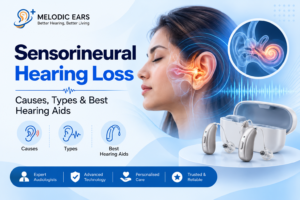
Sensorineural hearing loss occurs when there is damage to the hair cells in the inner ear or to the auditory nerve that transmits sound signals to the brain. It is the most common form of permanent hearing loss, accounting for roughly 90 percent of all hearing impairment in adults. Because medical or surgical procedures cannot repair damaged hair cells, modern digital hearing aids are the primary management solution to restore audibility and speech clarity.
Unlike conductive hearing loss, which stems from mechanical blockages in the outer or middle ear such as earwax or fluid, sensorineural hearing loss alters both the volume and the clarity of sound. People with this condition often report that they can hear that someone is speaking, but cannot distinguish the specific words, especially in noisy rooms.
What causes sensorineural hearing loss?
Sensorineural hearing loss (SNHL) develops when the delicate stereocilia (tiny sensory hair cells) lining the cochlea become damaged, fatigued, or broken, or when the auditory nerve fibres deteriorate. Once lost, these mammalian inner ear hair cells do not regenerate naturally.
The primary causes include:
- Ageing (Presbycusis): The natural breakdown of auditory structures over time. Age-related hearing loss typically begins in the high frequencies, affecting consonant recognition (such as s, f, th, and sh sounds).
- Noise exposure: Chronic exposure to workplace noise, industrial machinery, traffic, or loud music damages the cochlear hair cells. A single impulse sound, such as an explosion or firecracker close to the ear, can also cause acoustic trauma.
- Ototoxic medications: Certain medications damage inner ear structures. Common ototoxic drugs include high doses of aminoglycoside antibiotics (such as gentamicin), specific chemotherapy drugs (like cisplatin), and certain loop diuretics.
- Sudden sensorineural hearing loss (SSNHL): An unexplained, rapid loss of hearing that occurs all at once or over a period of up to three days. It is often viral or vascular in origin and is considered a medical emergency requiring immediate evaluation by an ENT specialist.
- Genetics and congenital factors: Genetic mutations can cause hearing loss present at birth or develop gradually later in life. Maternal infections during pregnancy, such as rubella or cytomegalovirus, can also impair cochlear development.
- Medical conditions: Acoustic neuroma (a benign tumour on the vestibular nerve), Ménière’s disease, autoimmune inner ear disease, diabetes, and cardiovascular conditions affecting microvascular blood flow to the cochlea can cause or accelerate inner ear damage.
- Physical trauma: Skull fractures or concussions can rupture inner ear membranes or sever auditory nerve pathways.
Types and classifications of sensorineural hearing loss
Audiologists classify sensorineural hearing loss using several diagnostic criteria based on an audiogram.
By onset and progression
- Congenital vs. acquired: Congenital hearing loss is present at birth. Acquired hearing loss develops later in life from illness, noise, trauma, or age.
- Sudden vs. gradual: Gradual hearing loss develops slowly over years, which is typical for presbycusis. Sudden hearing loss drops noticeably within hours or days and demands urgent medical care.
By affected ear
- Bilateral: Occurs in both ears. This is the standard presentation for age-related and noise-induced hearing loss.
- Unilateral: Affects only one ear. Unilateral loss requires focused medical investigation to rule out structural issues, viral infections, or tumours such as vestibular schwannoma.
By frequency configuration
- High-frequency hearing loss: The most frequent pattern, where low tones (vowels) sound normal, but high tones (consonants) fade away. Speech sounds muffled rather than quiet.
- Flat hearing loss: Sensitivity decreases roughly equally across low, mid, and high frequencies.
- Low-frequency hearing loss (Reverse slope): Uncommon; individuals hear high pitches normally but struggle with low pitches, often observed in early-stage Ménière’s disease.
How audiologists evaluate sensorineural hearing loss
Diagnosing sensorineural hearing loss requires formal clinical testing rather than a simple online screening. A comprehensive diagnostic battery at an audiology clinic includes:
- Otoscopy: A visual inspection of the outer ear and eardrum to eliminate earwax impaction, perforations, or middle-ear discharge.
- Pure Tone Audiometry (PTA): Determines hearing thresholds across frequencies from 250 Hz to 8000 Hz. Both air conduction (using headphones) and bone conduction (using an oscillator behind the ear) are tested. In sensorineural loss, air and bone conduction thresholds show the exact same degree of hearing loss without an “air-bone gap”.
- Speech Audiometry: Measures the Speech Reception Threshold (SRT) and the Speech Discrimination Score (SDS). This clarifies how accurately the brain interprets words when speech is loud enough.
- Tympanometry: Evaluates middle ear pressure and eardrum mobility to ensure no concurrent conductive problem exists.
Best hearing aid styles for sensorineural hearing loss
Because sensorineural hearing loss usually leaves low frequencies intact while weakening high frequencies, selecting the right device style is essential for natural sound quality.
Receiver-In-Canal (RIC)
RIC devices sit neatly behind the ear, while a fine wire runs into the ear canal carrying a miniature speaker (receiver). This design allows for “open-fit” domes, which let natural low frequencies enter the ear canal without obstruction while amplifying only the missing high frequencies. This eliminates the muffled, hollow sensation known as the occlusion effect. RIC hearing aids represent the most common recommendation for mild to severe sensorineural hearing loss.
Behind-The-Ear (BTE)
BTE devices house all electronics, including the speaker, inside a casing behind the ear. Sound travels through clear tubing into an ear mould. BTE models provide higher amplification power and durability, making them the standard choice for severe to profound sensorineural hearing loss, or for individuals with narrow ear canals or chronic moisture issues.
Custom in-the-ear styles (ITE, ITC, CIC, IIC)
Custom hearing aids sit directly inside the ear canal. While cosmetically appealing, these styles seal the canal. When low-frequency hearing is relatively normal, sealing the canal can make the user’s own voice sound boomy or echoing. Audiologists generally recommend custom canal devices for flat hearing losses or individuals who need a compact, discreet package and have adequate manual dexterity.
Key features to look for in hearing aids for SNHL
Sensorineural hearing loss reduces the ear’s ability to filter sound in challenging auditory environments. Modern hearing aids use specific digital processing tools to address this difficulty:
- Directional microphones: Microphone arrays focus on the voice of the person in front of you while attenuating background ambient noise from behind and beside you.
- Multi-channel frequency shaping: Allows the audiologist to apply precise amplification exclusively to the specific frequencies where your thresholds have dropped, leaving normal hearing bands untouched.
- Frequency lowering (compression or transposition): For severe high-frequency “dead regions” where hair cells cannot process sound at all, the processor captures inaudible high pitches and shifts them into an adjacent lower frequency range where the ear can still detect them.
- Noise reduction algorithms: Automatically identify steady background hums (such as ceiling fans, air conditioners, and engine rumbles) and reduce their gain without muffling conversational speech.
- Bluetooth streaming and app control: Streams phone calls, media, and television audio directly into both ears, bypassing room reverberation and distance.
Top hearing aid brands and pricing in India
In India, premium hearing care is supported by global manufacturers who operate dedicated distribution and service centres across metropolitan and Tier-2 cities. Reliable brands offering advanced technology for sensorineural hearing loss include:
- Phonak (Sonova): Known for robust performance in speech comprehension and universal Bluetooth connectivity compatible with Android and iOS smartphones. Lines like the Phonak Audéo Lumity and Infinio perform well in complex listening situations.
- Oticon (Demant): Utilises an “open sound” philosophy driven by deep neural networks (found in the Oticon Real and Intent platforms) to preserve full environmental awareness rather than aggressively cutting background sound.
- Signia (WS Audiology): Features split-processing technology (Integrated Xperience and Augmented Xperience platforms) that handles speech and ambient sounds through separate audio channels to enhance conversational clarity.
- Widex (WS Audiology): Known among musicians and discerning listeners for very low sound processing delay (Widex PureSound), delivering a natural acoustic profile without metallic distortion.
- ReSound (GN Hearing): Offers strong wireless connectivity, natural spatial awareness, and intuitive smartphone app customization options.
Estimated hearing aid cost range in India
Hearing aid pricing in India depends on the technology tier (entry-level, mid-range, or premium) rather than physical size alone. Prices are generally quoted per single device (one ear):
| Technology Tier | Approximate Price Range (Per Ear) | Best Suited For |
|---|---|---|
| Basic / Entry-Level | ₹25,000 – ₹50,000 | Quiet lifestyles, one-on-one conversations at home, simple TV viewing. |
| Mid-Range | ₹55,000 – ₹1,20,000 | Moderate social environments, small family gatherings, workplace meetings, telephone use. |
| Advanced / Premium | ₹1,30,000 – ₹3,50,000+ | Complex auditory settings, noisy restaurants, conferences, active travel, outdoor windy conditions. |
Device cost typically includes professional evaluation, device programming, follow-up verification appointments, and manufacturer warranties (usually two to four years).
When to seek immediate medical attention
Gradual sensorineural loss should be evaluated through a planned audiological consultation. However, sudden sensorineural hearing loss (SSNHL)—where hearing drops rapidly within a matter of hours or over a couple of days, often accompanied by tinnitus or a feeling of ear fullness—demands immediate medical treatment.
Consult an ENT specialist promptly if this occurs. Oral or intratympanic corticosteroid treatment is most effective when administered within the first 72 hours of symptom onset. Delaying treatment past two to three weeks significantly reduces the likelihood of recovering inner ear function.
Frequently asked questions
Can sensorineural hearing loss be reversed with medicine or surgery?
In the vast majority of cases, chronic sensorineural hearing loss cannot be reversed by medicine or surgery because damaged cochlear hair cells do not grow back. The main exception is sudden sensorineural hearing loss (SSNHL), which may partially or fully resolve if treated promptly with high-dose steroids under an ENT doctor’s guidance. For permanent loss, hearing aids or cochlear implants are the appropriate management paths.
Why do words sound mumbled even though I can hear sounds?
Sensorineural hearing loss most frequently damages high-frequency hearing first. Vowel sounds (a, e, i, o, u) are low frequency and provide the loudness of speech, while consonants (s, t, p, k, f) are high frequency and provide clarity and meaning. When high-frequency hearing drops, you can hear that someone is speaking, but without the consonants, words sound slurred or mumbled.
Do I need two hearing aids if both ears have sensorineural hearing loss?
If an audiogram indicates sensorineural loss in both ears, wearing two hearing aids (bilateral amplification) is standard clinical practice. Bilateral fitting enables the brain to localise sound sources, improves speech understanding in noisy environments, reduces listening effort, and prevents auditory deprivation in the untreated ear.
How long do hearing aids take to adjust to?
Adapting to hearing aids generally takes two to six weeks. Because sensorineural loss develops slowly, the auditory cortex becomes unaccustomed to everyday sounds such as footsteps, running water, and fan hums. When a hearing aid restores these frequencies, sounds may initially seem bright, sharp, or loud. Consistent daily wear allows the brain to acclimatise and filter out non-essential sounds again.
What is the difference between a hearing aid and a cochlear implant for SNHL?
A hearing aid amplifies acoustic sound to stimulate the remaining sensory hair cells in the cochlea. A cochlear implant bypasses damaged hair cells entirely. It consists of an internal electrode array surgically placed into the cochlea to stimulate the auditory nerve directly with electrical pulses. Cochlear implants are typically reserved for severe-to-profound sensorineural hearing loss where standard hearing aids no longer provide sufficient speech understanding.