
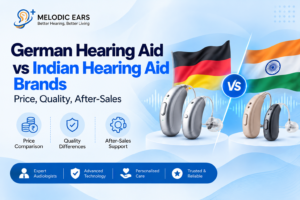
German hearing aids typically offer superior sound processing, background noise reduction, and Bluetooth connectivity, costing between ₹25,000 and ₹3,50,000 or more per ear. Indian hearing aid brands focus heavily on affordability and straightforward amplification, with prices ranging from ₹5,000 to ₹40,000. For complex listening environments, German engineering leads in clarity; for budget constraints and basic home listening, domestic Indian options provide practical utility.
Overview: German Engineering vs Domestic Manufacturing
When selecting a hearing aid in India, buyers frequently encounter two distinct categories: international devices with German engineering roots and Indian brands built locally. Understanding how these two groups differ across pricing, sound quality, and long-term service helps buyers match their hearing loss level and daily routine with the right device.
German brands in the hearing care sector trace their origins back to early medical acoustics. Brands such as Signia (formerly Siemens Hearing Instruments), Audio Service, and Rexton are designed with proprietary digital microchips, multi-channel sound processing, and directional microphone systems. These brands operate under parent corporations like WS Audiology, with dedicated research centers in Germany and Singapore, and their devices are distributed across clinics nationwide in India.
Indian brands, including longstanding manufacturers such as, Melodic Ears, Alps, Elkon, and Arphi, alongside newer domestic health-tech entrants, approach the market from a value-driven angle. Many of these manufacturers develop body-worn devices, behind-the-ear (BTE) models, and basic digital programmable units tailored for domestic clinic supply, public health programs, and price-conscious consumers. Rather than competing directly in proprietary artificial intelligence or complex directional processing, domestic makers prioritize straightforward amplification, durable outer housings, and accessible price points.
Also Read- Types of Hearing Aids Explained: Which One is Right for You?
Price Comparison Across Tiers
Pricing for hearing aids in India depends on the processing technology inside the chip, form factor (such as invisible-in-the-canal versus standard behind-the-ear), and the channel configuration. Hearing aids are priced individually per unit, though some clinics offer package pricing for bilateral fittings.
| Category | German Brands (Signia, Audio Service, Rexton) | Indian Brands (Alps, Elkon, Domestic Makers) |
|---|---|---|
| Basic / Entry-Level | ₹20,000 – ₹45,000 per ear | ₹5,000 – ₹15,000 per ear |
| Mid-Range Digital | ₹50,000 – ₹1,20,000 per ear | ₹16,000 – ₹35,000 per ear |
| Premium / Flagship | ₹1,30,000 – ₹3,50,000+ per ear | Rarely available above ₹40,000 – ₹50,000 |
| Battery System | Rechargeable lithium-ion or zinc-air button cells | Primarily standard zinc-air or AA/AAA (for pocket types) |
German entry-level digital aids often provide 12 to 16 processing channels with basic noise suppression. Indian digital models in the same entry-level bracket generally offer 4 to 8 channels. For users on a strict budget who need reliable sound amplification primarily for quiet environments, domestic brands provide functional devices at a fraction of the cost.
Also Read- Rechargeable Hearing Aids vs Battery: Which Is Better?
Sound Quality, Processing, and Durability
Sound quality in modern hearing aids involves more than making sounds louder. It requires distinguishing human speech from background sounds like traffic, ceiling fans, kitchen noise, and crowded rooms.
Speech Processing in Noise
German platforms use dual-microphone systems that coordinate to focus on speakers in front of the wearer while reducing ambient noise from the sides and rear. High-tier models track multiple speakers simultaneously. This feature is particularly useful in noisy Indian outdoor settings, wedding functions, and joint-family environments.
Indian brands generally employ broader acoustic amplification. While modern digital models from domestic companies include basic noise filters, their algorithms are less granular. In a quiet living room, television dialogue or one-on-one conversation sounds clear. In a busy market or noisy restaurant, however, Indian devices can amplify background rumble alongside speech, requiring the user to manually turn down the volume.
Climate Resistance and Build Quality
India’s climate presents challenges for delicate electronics due to high humidity, sweat, and dust. German manufacturers routinely build devices rated IP68 for water and dust ingress. Their microchips feature hydrophobic coatings designed to prevent sweat-induced corrosion.
Indian manufacturers design hardware with physical durability in mind. Pocket models and basic BTE units from brands like Elkon and Alps use thicker outer plastic shells that withstand accidental drops. However, internal moisture protection varies, so users who sweat heavily or live in coastal areas may need frequent dehumidifier box storage regardless of the brand chosen.
Connectivity and App Controls
German hearing aids integrate Bluetooth Low Energy, allowing direct audio streaming from Android and iOS smartphones, television streamers, and remote microphones. Patients can alter program modes, volume, and directional focus through smartphone applications.
Most Indian hearing aids operate independently of smartphones. Adjustments are made via physical push buttons, volume rocker switches, or trimmers adjusted by a technician using a small screwdriver. Some newer domestic digital models connect to programming software via PC cables, but direct phone audio streaming is rarely supported.
After-Sales Service and Maintenance in India
A hearing aid requires ongoing tuning, cleaning, and occasional component replacement. After-sales support often determines whether a user continues wearing their device long-term.
Service Networks and Repair Turnaround
German manufacturers maintain authorized national service depots in metropolitan hubs like Mumbai, Delhi, Bengaluru, and Chennai. Local independent audiologists send aids to these centers for transducer replacements, shell remakes, and internal circuitry repairs. Turnaround times typically range from 5 to 10 working days. Many clinics provide temporary loaner units during extended repairs.
Indian manufacturers have direct factory depots or regional distributor workshops across tier-1 and tier-2 cities. Because spare parts are produced or sourced domestically, repair costs after the warranty period expires are substantially lower. Replacing a microphone, receiver, or battery contact on an Indian brand can cost between ₹500 and ₹2,500, whereas repairs on European platforms outside of warranty often range from ₹3,000 to ₹12,000 depending on the component.
Dispenser and Audiologist Support
Most university-trained audiologists in India are equipped with fitting software for major international manufacturers, including German platforms. They can perform precise Real Ear Measurements (REM) and fine-tune frequency responses across individual channels to match an audiogram.
Support for domestic brands is more common among government hospitals, charitable institutions, and local hearing aid dealers. Some independent clinics may not maintain programming cables or up-to-date proprietary software for domestic digital models, relying instead on factory presets. Buyers considering Indian brands should confirm that a local service provider can reprogram the aid if their hearing thresholds change over time.
Which Option Fits Your Needs?
When German Brands Make Sense
- Active lifestyles involving frequent travel, conferences, restaurant visits, or noisy social settings.
- Sensory needs requiring direct wireless streaming for phone calls and media.
- Complex audiometric profiles, such as steep high-frequency hearing loss or severe recruitment, where multi-channel compression is required.
- Users seeking discreet custom styles like completely-in-canal (CIC) or receiver-in-canal (RIC) designs.
When Indian Brands Make Sense
- Strict budget constraints where the primary requirement is dependable sound amplification under ₹20,000.
- First-time elderly users who stay primarily indoors and find smartphone apps or small buttons difficult to manage.
- Buyers seeking low long-term repair and spare-part replacement expenses.
- Patients living in areas where local dispensers primarily stock and service regional domestic lines.
Also Read- Melodic Ears – Your Trusted Hearing Aid Brand for Better Hearing and Happier Living
Frequently Asked Questions
Are German hearing aids better than Indian brands for severe hearing loss?
Both German and Indian brands manufacture high-power (Super Power and Ultra Power) devices that handle severe to profound hearing loss. German models provide cleaner sound separation and feedback management at high volume levels, preventing whistling sounds. Indian high-power models deliver strong, loud output at a lower price point but may produce more background distortion in loud environments.
How long do German hearing aids last compared to Indian hearing aids?
A well-maintained hearing aid from either origin typically lasts between 4 and 7 years. German devices depend on delicate microchips that need protection from sweat and moisture to reach this mark. Indian devices often have sturdier outer casings, but physical switches, cords, and battery doors may require servicing after 2 to 3 years of daily use.
What is the typical warranty period in India?
German manufacturers usually offer a 2- to 4-year standard warranty on digital models, covering internal components against manufacturing defects. Indian brands generally provide a 1- to 2-year warranty. Warranties from both categories exclude physical breakage, liquid immersion, and damage caused by battery leakage.
Can Indian hearing aids be connected to a smartphone?
Most Indian brand hearing aids do not feature Bluetooth connectivity or smartphone pairing. They function as standalone acoustic amplifiers. If wireless phone calls and app controls are necessary, German or other international brands are typically required.
Are spare parts for German hearing aids expensive in India?
Yes, replacement parts for German hearing aids cost more than those for domestic devices because specialized receivers, micro-microphones, and rechargeable power cells are imported. Earwax guards and silicone domes are inexpensive, but circuit repairs or receiver replacements outside the warranty period can be costly.