Navigating the world of hearing aids can feel overwhelming. With advancements in technology and design, there’s a vast array of options, each promising to restore clarity and connection to your world. But with so many types of hearing aids available, how do you determine which one is the ideal fit for your unique needs, lifestyle, and degree of hearing loss?
This comprehensive guide aims to demystify the choices, providing a detailed explanation of ten common types of hearing aids. We’ll delve into their design, functionality, advantages, and limitations, helping you understand the nuances that differentiate them. Our goal is to empower you with the knowledge needed to have an informed discussion with your hearing care professional, ultimately leading you to the right solution for better hearing.
Understanding Hearing Loss and the Role of Hearing Aids
Before diving into specific types of devices, it’s helpful to understand the fundamental purpose of hearing aids. Hearing loss affects millions worldwide, manifesting in various forms and severities. Most commonly, it’s sensorineural hearing loss, which involves damage to the delicate hair cells in the inner ear or the auditory nerve. Conductive hearing loss, on the other hand, involves problems with sound transmission through the outer or middle ear.
Hearing aids are sophisticated electronic devices designed to amplify sound, making it easier for individuals with hearing loss to hear and understand speech and environmental sounds. They typically consist of three main components:
- A microphone: To pick up sound waves.
- An amplifier: To increase the volume of the sound.
- A speaker (receiver): To deliver the amplified sound into the ear canal.
Modern hearing aids often incorporate advanced digital signal processing, allowing them to filter out background noise, adjust to different listening environments, and even connect wirelessly to smartphones and other devices. The “right” hearing aid isn’t just about amplification; it’s about providing the most natural and effective listening experience possible, tailored to the specific type and pattern of an individual’s hearing loss, as well as their personal preferences and lifestyle.
The 10 Types of Hearing Aids Explained in Detail
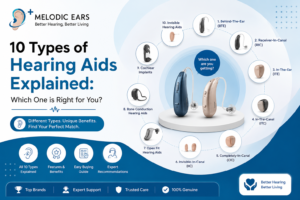
Here, we explore the primary types of hearing aids you’ll encounter, each offering distinct characteristics in terms of size, placement, power, and features.
1. Behind-The-Ear (BTE) Hearing Aids
The BTE hearing aid is arguably the most recognizable style. It features a durable casing that sits comfortably behind the outer ear, containing most of the electronic components. A clear plastic tube connects the casing to a custom-made earmold or a standard dome, which fits inside the ear canal.
BTE devices are known for their robust power output, making them suitable for a wide range of hearing loss severities, from mild to profound. Their larger size allows for more powerful batteries, larger controls, and often more advanced features. They are particularly popular for children due to their durability, ease of handling, and compatibility with various assistive listening devices.
Pros of BTE Hearing Aids:
- Versatility: Suitable for nearly all types and degrees of hearing loss, including severe to profound.
- Power: Typically offer the most amplification and battery life.
- Durability: Less susceptible to moisture and wax damage because components are outside the ear canal.
- Ease of Use: Larger controls are easier to manipulate, and batteries are simpler to change.
- Connectivity: Often feature advanced connectivity options (Bluetooth, telecoil) and are compatible with FM systems.
- Comfort: The lightweight design distributes weight evenly.
- Maintenance: Easier to clean and maintain.
Cons of BTE Hearing Aids:
- Visibility: More visible than other styles, which can be a cosmetic concern for some users.
- Wind Noise: The microphone’s placement behind the ear can make them more susceptible to wind noise.
- Ear Canal Occlusion: Can sometimes cause a “plugged-up” feeling, especially with traditional earmolds.
Ideal Candidate for BTE Hearing Aids:
Individuals with moderate to profound hearing loss, those who prioritize robust performance and features over discreetness, people with dexterity issues, and children.
Also Read- Noise Pollution and Hearing Health: How Urban Living May Affect Your Ears
2. Receiver-In-Canal (RIC) / Receiver-In-Ear (RITE) Hearing Aids
The RIC hearing aid (sometimes referred to as RITE, meaning Receiver-In-The-Ear) has become incredibly popular due to its blend of discreetness and performance. Similar to a BTE, the main body of the hearing aid sits behind the ear. However, instead of a hollow tube, a thin electrical wire connects the device to a tiny speaker (receiver) that rests directly inside the ear canal, covered by a small, soft dome or a custom-made mold.
This design allows the receiver to be closer to the eardrum, often providing a more natural sound quality with less distortion. The separation of the receiver from the main body also makes the device behind the ear smaller and less conspicuous than a traditional BTE.
Pros of RIC/RITE Hearing Aids:
- Discreetness: Smaller and less visible than traditional BTEs.
- Natural Sound: Receiver placement closer to the eardrum often results in clearer, more natural sound.
- Comfort: Open-fit domes minimize the “plugged-up” sensation (occlusion).
- Versatility: Suitable for mild to severe hearing loss.
- Flexibility: The receiver can be easily replaced if power needs change or if it becomes damaged.
- Rechargeable Options: Many RIC models are available with convenient rechargeable batteries.
Cons of RIC/RITE Hearing Aids:
- Fragility: The thin wire and receiver in the ear canal can be more susceptible to moisture, earwax, and physical damage.
- Maintenance: Requires more frequent cleaning of the receiver and dome/mold.
- Power Limitations: While powerful, they may not offer the extreme amplification levels of the largest BTEs.
Ideal Candidate for RIC/RITE Hearing Aids:
Individuals with mild to severe hearing loss who desire a less visible device, prioritize natural sound quality, and are comfortable with a bit more delicate maintenance.
3. In-The-Ear (ITE) Hearing Aids
The ITE hearing aid is custom-made to fit the unique contours of an individual’s outer ear and ear canal. All components are housed within a single shell that fills most of the concha (the bowl-shaped part) of the outer ear. ITEs are available in two main styles:
- Full Shell ITE: Fills most of the concha. Offers space for larger batteries, controls, and features. Suitable for moderate to severe hearing loss.
- Half Shell ITE: Fills only the lower part of the concha. More discreet than full shell but with slightly fewer feature options. Suitable for mild to moderately severe hearing loss.
The ITE hearing aid provides a balance between discreetness and functionality, offering more features and power than smaller in-canal styles while being less visible than BTEs.
Pros of ITE Hearing Aids:
- Custom Fit: Precisely molded to your ear, ensuring a secure and comfortable fit.
- Easy Handling: Larger size makes them easier to insert, remove, and adjust for those with dexterity issues.
- Features: Can accommodate larger batteries (longer life), larger controls, and more advanced features like telecoils.
- Visibility: More discreet than BTEs, though still visible in the outer ear.
- Microphone Placement: Often offers better directionality due to the ear’s natural funneling of sound.
Cons of ITE Hearing Aids:
- Visibility: Still visible, which may be a concern for some.
- Occlusion Effect: Can cause a “plugged-up” feeling due to blocking the ear canal.
- Wax Buildup: More susceptible to earwax and moisture damage than BTEs, as components are in the ear.
- Less Flexible: Requires a new shell if the ear canal changes size over time.
Ideal Candidate for ITE Hearing Aids:
Individuals with mild to severe hearing loss, those who prefer an in-ear device but need larger controls or more power/features, and those with dexterity challenges.
Also Read- Hearing Loss in Seniors: Early Signs Families Shouldn’t Ignore
4. In-The-Canal (ITC) Hearing Aids
The ITC hearing aid is a step smaller and more discreet than an ITE device. It is custom-made to fit just inside the ear canal, with only a small portion visible in the outer ear bowl. Like ITEs, all electronic components are housed within the custom shell.
ITC devices strike a balance between aesthetics and functionality, being less visible than BTEs and ITEs while still being large enough to incorporate some useful features and provide adequate power for many types of hearing loss.
Pros of ITC Hearing Aids:
- Discreetness: Less visible than BTE or ITE models, sitting further into the ear canal.
- Comfort: Custom-made for a secure and comfortable fit.
- Natural Sound: Microphone placement within the ear canal can take advantage of the ear’s natural acoustics.
- Battery Life: Offers reasonable battery life compared to smaller in-canal options.
Cons of ITC Hearing Aids:
- Dexterity: Smaller size can make them more challenging to handle for individuals with limited dexterity.
- Features: Space constraints limit the number and size of features (e.g., smaller battery, fewer manual controls, limited connectivity).
- Wax and Moisture: Highly susceptible to earwax buildup and moisture damage due to deep placement in the canal.
- Occlusion: Can still cause some occlusion effect.
Ideal Candidate for ITC Hearing Aids:
Individuals with mild to moderate hearing loss who prioritize discreetness but still desire some basic controls or a slightly longer battery life than completely invisible options. Good for those with average dexterity.
Also Read- The Ultimate Guide to Choosing the Right Hearing Aid: Everything You Need to Know
5. Completely-In-Canal (CIC) Hearing Aids
The CIC hearing aid is designed to fit entirely within the ear canal, making it almost invisible to others. Only a tiny removal string typically extends slightly into the outer ear, used for easy insertion and removal. The custom-molded shell houses all the electronics deep within the ear canal.
The “CIC hearing aid” is a popular choice for those seeking maximum discretion, often referred to under the umbrella of “invisible hearing aid” options. Their deep placement means they utilize the natural acoustics of the ear, which can result in a very natural sound experience.
Pros of CIC Hearing Aids:
- High Discretion: Virtually invisible, meeting cosmetic preferences for many users.
- Natural Sound: Microphone placement deep within the ear canal leverages the ear’s natural resonance, often leading to a more natural sound experience.
- Reduced Wind Noise: Protected from wind by the outer ear.
- No Occlusion (sometimes): For some users, the deep fit can reduce the occlusion effect compared to ITC or ITE.
Cons of CIC Hearing Aids:
- Power Limitations: Small size restricts power, making them suitable only for mild to moderate hearing loss.
- Battery Life: Very small batteries require frequent replacement (every few days).
- Dexterity: Difficult to handle for those with poor dexterity or vision due to their tiny size.
- Features: Limited space means minimal or no manual controls, and limited connectivity options (e.g., no Bluetooth, no telecoil).
- Maintenance: Highly susceptible to earwax, moisture, and debris buildup, requiring diligent cleaning.
- Fit Issues: Not suitable for all ear canal shapes or those with excessive earwax production.
Ideal Candidate for CIC Hearing Aids:
Individuals with mild to moderate hearing loss who prioritize ultimate discretion, have good dexterity, minimal earwax, and are comfortable with frequent battery changes and careful maintenance.
Also Read- 5 Ways to Prevent Hearing Loss While Using Headphones
6. Invisible-In-Canal (IIC) Hearing Aids
The IIC hearing aid is the smallest and most discreet of all custom hearing aids, pushing the boundaries of what an “invisible hearing aid” can be. It sits even deeper than a CIC, completely out of sight within the second bend of the ear canal. Like the CIC, it usually features a tiny removal string for handling.
These devices are the epitome of cosmetic appeal, offering an unnoticeable hearing solution. However, their ultra-small size comes with significant trade-offs in terms of power, battery life, and available features.
Pros of IIC Hearing Aids:
- Maximum Discretion: Completely invisible when worn, offering unparalleled cosmetic appeal.
- Natural Sound: Deep placement further utilizes the ear’s natural acoustics, enhancing sound localization and reducing wind noise.
- Comfort: Custom fit ensures comfort for long wear.
Cons of IIC Hearing Aids:
- Hearing Loss Range: Only suitable for mild to moderate hearing loss due to power limitations.
- Battery Life: Smallest batteries mean the shortest battery life, often requiring daily replacement.
- Dexterity: Extremely difficult to handle for those with any dexterity issues.
- Features: Virtually no manual controls (volume, program changes) and very limited connectivity.
- Maintenance: Highest susceptibility to wax and moisture damage, demanding meticulous daily cleaning.
- Fit Constraints: Not suitable for all ear canals (e.g., very narrow or convoluted canals) or those with chronic ear infections or excessive wax.
Ideal Candidate for IIC Hearing Aids:
Individuals with mild to moderate hearing loss who demand absolute invisibility, have excellent dexterity, minimal earwax, and are willing to accept compromises in features and battery life.
Also Read- The Future of Hearing Aids: How AI Is Redefining Hearing Care in India
7. Open-Fit Hearing Aids (Often RIC or BTE Style)
While often a style of BTE or RIC, “Open-Fit” refers specifically to the fitting approach rather than a distinct hearing aid type. In an open-fit configuration, the behind-the-ear unit (either a BTE or RIC) is connected to the ear canal via a thin tube or wire, which terminates in a small, non-occluding dome that sits loosely in the ear canal.
The key characteristic is that the ear canal is left largely “open,” allowing natural low-frequency sounds to enter the ear while only amplifying the high-frequency sounds where hearing loss is typically present. This design dramatically reduces the “plugged-up” feeling (occlusion effect) that many users experience with traditional earmolds.
Pros of Open-Fit Hearing Aids:
- Reduced Occlusion: Allows low-frequency sounds to enter naturally, eliminating the “plugged-up” feeling.
- Natural Sound: Can provide a more natural sound experience, especially for individuals with good low-frequency hearing.
- Comfort: Lightweight and comfortable due to the open dome.
- Discreetness: Often very small and blend in well, especially open-fit RICs.
- Less Feedback: Modern open-fit devices have sophisticated feedback cancellation to prevent whistling.
Cons of Open-Fit Hearing Aids:
- Limited Power: Not suitable for severe or profound hearing loss, as high amplification can lead to feedback.
- Low-Frequency Loss: Ineffective for individuals with significant low-frequency hearing loss, as it doesn’t adequately block out natural sound.
- Domes Can Fall Out: While comfortable, domes can sometimes slip out of place.
Ideal Candidate for Open-Fit Hearing Aids:
Individuals with mild to moderate high-frequency hearing loss who have relatively good low-frequency hearing and are bothered by the occlusion effect of traditional fittings.
Also Read- Hearing Aid Price in India 2026 – Complete Price List (All Brands)
8. Extended Wear Hearing Aids (e.g., Phonak Lyric)
Extended wear hearing aids represent a unique category due to their design for prolonged, continuous use. The most prominent example is the Phonak Lyric, often referred to as an “invisible contact lens for the ear.” This device is custom-fitted deep within the ear canal, just inches from the eardrum, and is designed to be worn 24/7 for several months at a time, through showering, sleeping, and exercise.
Unlike other hearing aids that are inserted and removed daily, extended wear devices require professional insertion and removal by a trained hearing care specialist. They are powered by an internal battery that lasts for months, after which the device is replaced with a new one.
Pros of Extended Wear Hearing Aids:
- True Invisibility: Sits so deep it’s completely undetectable.
- Convenience: No daily insertion, removal, or battery changes.
- 24/7 Hearing: Provides continuous hearing, even while sleeping, which can be beneficial for safety and situational awareness.
- Natural Sound: Deep placement takes full advantage of the ear’s natural anatomy for sound localization and reduced wind noise.
Cons of Extended Wear Hearing Aids:
- Monthly Subscription/Cost: Typically purchased on a subscription basis, with regular replacements.
- Limited Adjustments: No user controls for volume or programs.
- Hearing Loss Range: Suitable only for mild to moderately severe hearing loss.
- Not for Everyone: Requires a specific ear canal size and shape; not compatible with all anatomies or excessive earwax/infections.
- Maintenance: Cannot be self-maintained; requires professional intervention for replacement or adjustments.
- Moisture Risk: While water-resistant, prolonged exposure to moisture can reduce lifespan.
Ideal Candidate for Extended Wear Hearing Aids:
Individuals with mild to moderately severe hearing loss who prioritize constant, invisible hearing without daily hassle, are comfortable with regular professional maintenance, and have suitable ear canal anatomy.
9. CROS/BiCROS Hearing Aids
CROS (Contralateral Routing of Signal) and BiCROS (Bilateral Contralateral Routing of Signal) systems are specialized types of hearing aids designed for individuals with single-sided deafness (SSD) or asymmetrical hearing loss.
- CROS System: For individuals with hearing loss in one ear and normal hearing in the other. A microphone on the deaf ear picks up sound and wirelessly transmits it to a receiver placed on the good ear. This allows the good ear to hear sounds from both sides, improving situational awareness.
- BiCROS System: For individuals with hearing loss in one ear (the “dead” ear) and hearing loss in the other ear (the “better” ear). Similar to CROS, a microphone on the “dead” ear transmits sound to the “better” ear, which also receives amplification for its own hearing loss.
These systems help to overcome the “head shadow” effect, where sounds coming from the side of the poorer ear are difficult to hear, and improve speech understanding in noise.
Pros of CROS/BiCROS Hearing Aids:
- Improved Awareness: Allows the user to hear sounds from the side of their poorer ear.
- Better Speech Understanding: Can significantly improve speech comprehension in noisy environments and when the speaker is on the side of the deaf ear.
- Reduced Head Shadow: Mitigates the difficulty of hearing sounds on the “bad” side.
Cons of CROS/BiCROS Hearing Aids:
- No Stereo Hearing: Does not restore true stereo hearing or sound localization.
- Requires Two Devices: Involves wearing a device on each ear, even if one ear has normal hearing (for CROS).
- Battery Drain: Wireless transmission can lead to faster battery drain.
- Cost: Can be more expensive due to the specialized technology.
Ideal Candidate for CROS/BiCROS Hearing Aids:
Individuals with single-sided deafness (SSD) or asymmetrical hearing loss, where one ear has significantly poorer hearing than the other, who struggle to hear sounds coming from their “dead” side.
10. Bone-Anchored Hearing Systems (BAHS) / Bone Conduction Hearing Aids
Bone-Anchored Hearing Systems (BAHS), sometimes referred to as bone conduction hearing aids, are fundamentally different from conventional air-conduction hearing aids. Instead of amplifying sound waves through the ear canal and middle ear, BAHS bypass the outer and middle ear entirely, transmitting sound vibrations directly to the inner ear (cochlea) through the skull bone.
This system consists of an external sound processor and a small titanium implant surgically placed in the bone behind the ear. The sound processor converts sound into vibrations, which are then transferred through the implant to the inner ear. These are often used for conductive hearing loss, mixed hearing loss, or single-sided deafness when conventional hearing aids are not suitable or effective.
Pros of BAHS:
- Effective for Specific Losses: Excellent solution for conductive hearing loss, mixed hearing loss, or single-sided deafness where air conduction is blocked or ineffective.
- Clear Sound: Can provide very clear sound quality by bypassing damaged outer/middle ear structures.
- Open Ear Canal: Leaves the ear canal open, preventing moisture buildup and allowing natural sound to enter if there is some residual hearing.
- Cosmetic Options: Modern processors can be quite discreet, and some even offer soft-band options for children or trial periods before surgery.
Cons of BAHS:
- Surgical Procedure: Requires a minor surgical procedure for the implant.
- Cost: Generally more expensive than conventional hearing aids.
- Maintenance: Requires cleaning around the abutment (if external) and care of the processor.
- Cosmetic Concerns: While discreet, there is a visible external processor.
- Not for All Hearing Loss: Not suitable for sensorineural hearing loss where the inner ear itself is severely damaged.
Also Read- Common Ear Infections and What They May Indicate About Your Health
Ideal Candidate for BAHS:
Individuals with conductive hearing loss (e.g., chronic ear infections, malformed ear canal), mixed hearing loss, or single-sided deafness who cannot benefit from or wear conventional air-conduction hearing aids.
Comparison of Hearing Aid Types
To help visualize the differences, here’s a comparative table summarizing the key aspects of the ten types of hearing aids discussed:
| Hearing Aid Type | Placement | Visibility | Hearing Loss Range | Key Advantages | Key Disadvantages | Typical Features |
|---|---|---|---|---|---|---|
| 1. Behind-The-Ear (BTE) | Behind the ear, tube to earmold/dome. | Visible | Mild to Profound | Most powerful, durable, easy handling, full features. | Most visible, potential for wind noise. | Telecoil, Bluetooth, directional mics, rechargeable. |
| 2. Receiver-In-Canal (RIC/RITE) | Behind the ear, thin wire to receiver in canal. | Discreet | Mild to Severe | Natural sound, discreet, comfortable open fit. | Receiver prone to wax/moisture, delicate wire. | Bluetooth, rechargeable, multi-programs. |
| 3. In-The-Ear (ITE) | Fills outer ear bowl. | Visible in outer ear | Mild to Severe | Custom fit, easy handling, larger batteries/controls. | Can feel occluding, susceptible to wax/moisture. | Telecoil, some Bluetooth, directional mics. |
| 4. In-The-Canal (ITC) | Fits mostly in ear canal, small part visible. | Less visible | Mild to Moderately Severe | Discreet, custom fit, good sound. | Smaller size, limited features/battery life, wax/moisture risk. | Basic controls, some wireless. |
| 5. Completely-In-Canal (CIC) | Fits entirely within ear canal. | Virtually invisible | Mild to Moderate | Highly discreet, natural sound, reduced wind noise. | Short battery life, difficult handling, limited features, high wax risk. | Minimal controls, no Bluetooth. |
| 6. Invisible-In-Canal (IIC) | Deepest fit, completely out of sight. | Completely invisible | Mild to Moderate | Ultimate discretion, natural sound, lowest wind noise. | Very short battery life, extremely difficult handling, almost no features, highest wax risk. | None (automatic). |
| 7. Open-Fit | BTE/RIC with open dome in ear canal. | Discreet (like RIC) | Mild to Moderate High-Freq | Eliminates occlusion, natural low-frequency sound. | Not for severe loss or low-frequency loss, potential for feedback. | Varies by BTE/RIC model (Bluetooth, rechargeable). |
| 8. Extended Wear (e.g., Lyric) | Deeply placed, worn for months. | Completely invisible | Mild to Moderately Severe | 24/7 hearing, ultimate convenience, truly invisible. | Subscription cost, no user control, not for all ears, professional replacement. | None (always on, automatic). |
| 9. CROS/BiCROS | Microphone on poorer ear, receiver on better/good ear. | Visible (like BTE/RIC) | Single-Sided Deafness / Asymmetrical Loss | Improved awareness from “dead” side, better speech in noise. | No true stereo hearing, requires two devices, battery drain. | Varies by BTE/RIC model for the receiver part. |
| 10. Bone-Anchored Hearing System (BAHS) | Sound processor on surgically implanted abutment/magnet. | Visible (external processor) | Conductive, Mixed, Single-Sided Deafness | Bypasses outer/middle ear issues, clear sound for specific losses. | Requires surgery, higher cost, external component. | Connectivity, noise reduction (processor-dependent). |
Which One is Right for You? Factors to Consider When Choosing Hearing Aids
Selecting the right hearing aid is a highly personal decision. There’s no single “best” type; instead, there’s a best type for you. Here are the critical factors to evaluate when making your choice:
1. Degree and Type of Hearing Loss
This is the most fundamental factor. Your audiologist will perform a comprehensive hearing test and create an audiogram, which maps your hearing thresholds across different frequencies.
- Mild to Moderate Hearing Loss: Many types are suitable, including RIC, ITE, ITC, CIC, IIC, and open-fit.
- Severe to Profound Hearing Loss: Typically requires the powerful amplification offered by BTE models or, in some specific cases, BAHS.
- Conductive or Mixed Hearing Loss: May benefit from BAHS if conventional aids are ineffective.
- Single-Sided Deafness: CROS/BiCROS systems are specifically designed for this.
The shape of your hearing loss (e.g., primarily high-frequency, flat, or reverse slope) will also influence the best choice. For instance, open-fit hearing aids are excellent for high-frequency loss with good low-frequency hearing.
2. Lifestyle and Activity Level
Your daily routine and activities play a significant role in determining the ideal hearing aid.
- Active Lifestyle (Sports, Outdoors): Durable BTEs or water-resistant RICs might be preferred. Extended wear hearing aids offer convenience for those who are always on the go.
- Quiet Home/Work Environment: Smaller, more discreet in-canal devices might suffice if background noise isn’t a major concern.
- Challenging Listening Environments (Meetings, Restaurants): Devices with advanced features like directional microphones, noise reduction, and strong connectivity (Bluetooth, telecoil) are crucial for these situations. BTEs and RICs often excel here.
3. Cosmetic Concerns and Discretion
For many, the visibility of a hearing aid is a primary concern.
- Maximum Invisibility: IIC, CIC, and Extended Wear devices are the top choices.
- Highly Discreet: RIC and Open-Fit styles offer a good balance of discretion and features.
- Less Concerned with Visibility: BTE and ITE models offer more power, features, and ease of handling, which might outweigh cosmetic concerns.
4. Budget
Hearing aids represent a significant investment, and prices vary widely based on technology level, features, and type.
- Entry-Level/Basic: Often ITE, ITC, or less advanced BTEs.
- Mid-Range: Most RICs, BTEs, and some custom models.
- Premium/Advanced: Top-tier RICs, BTEs, and specialized systems like CROS/BiCROS or BAHS. Extended wear devices also come with a unique subscription model cost.
Consider the long-term cost, including batteries (rechargeable vs. disposable), maintenance, and potential repairs. Insurance coverage for hearing aids also varies greatly.
5. Dexterity and Vision
The ability to handle small devices and see tiny controls is crucial for daily use and maintenance.
- Limited Dexterity/Vision: Larger BTE and ITE models with bigger buttons, easier battery compartments, and robust design are often the best choice. Rechargeable options also eliminate fiddling with tiny batteries.
- Good Dexterity/Vision: Can comfortably manage smaller ITC, CIC, or IIC devices.
6. Desired Features and Technology
Modern hearing aids come packed with sophisticated features. Consider which ones are most important to you:
- Connectivity: Bluetooth for streaming calls, music, and TV directly to your hearing aids.
- Rechargeability: Eliminates the need for disposable batteries.
- Telecoil: For better hearing in public venues equipped with hearing loops (theaters, churches).
- Directional Microphones: Improves speech understanding in noisy environments.
- Noise Reduction: Filters out unwanted background noise.
- Tinnitus Maskers: Built-in sound generators to alleviate tinnitus.
- Remote Control/App Control: For discreet adjustments via smartphone.
Generally, larger hearing aids (BTE, RIC, ITE) have more space for these advanced features, while smaller in-canal devices (CIC, IIC) have limited or no feature options.
7. Ear Canal Anatomy and Ear Health
Your physical ear structure and health history can impact which hearing aid styles are suitable.
- Narrow or Convoluted Canals: May not accommodate IIC or even CIC devices.
- Chronic Ear Infections or Excessive Earwax: Devices that sit deeply in the canal (ITC, CIC, IIC) might exacerbate issues or require constant maintenance. BTEs or RICs with components outside the ear might be better.
- Moisture/Sweating: BTEs are generally more robust against moisture.
The Importance of Professional Consultation
While this article provides extensive information on the types of hearing aids, it serves as a guide, not a substitute for professional medical advice. The journey to better hearing must begin with a comprehensive evaluation by a qualified hearing care professional, such as an audiologist or a licensed hearing aid dispenser. They will:
- Conduct thorough diagnostic tests to precisely determine the type, degree, and configuration of your hearing loss.
- Evaluate your ear anatomy and overall ear health.
- Discuss your lifestyle, communication needs, cosmetic preferences, and budget.
- Recommend specific types and models of hearing aids that are most appropriate for your unique profile.
- Custom-fit and program the selected devices to ensure optimal performance and comfort.
- Provide ongoing support, adjustments, and maintenance to ensure your hearing aids continue to meet your needs.
An experienced professional will guide you through the trial period, making necessary adjustments to fine-tune the devices to your specific listening environments and ensure you achieve the best possible hearing outcomes.
Conclusion
Choosing among the many types of hearing aids available today is a significant decision that impacts your daily life and ability to connect with the world around you. From the robust power of the Behind-The-Ear (BTE) to the discreet invisibility of the Invisible-In-Canal (IIC), each style offers a unique set of advantages and considerations. We’ve explored popular options like the versatile Receiver-In-Canal (RIC hearing aid), the custom-fit In-The-Ear (ITE hearing aid), and the ultra-compact Completely-In-Canal (CIC hearing aid), alongside specialized solutions like Open-Fit, Extended Wear, CROS/BiCROS, and Bone-Anchored Systems.
Ultimately, the “right” hearing aid is one that effectively addresses your specific hearing loss, comfortably fits your ear and lifestyle, aligns with your cosmetic preferences, and provides the features you need to thrive in all listening situations. Armed with the knowledge from this guide, you are now better prepared to discuss your options with confidence. Remember, the expertise of a hearing care professional is invaluable in navigating these choices and ensuring you find the perfect match for your journey to improved hearing.
Also Read- Melodic Ears – Your Trusted Hearing Aid Brand for Better Hearing and Happier Living
FAQs About Hearing Aids
Q1: What is the most common type of hearing aid?
A1: Currently, the Receiver-In-Canal (RIC) hearing aid is one of the most popular and commonly dispensed types. Its balance of discreetness, natural sound quality, and feature richness makes it a versatile choice for many individuals with mild to severe hearing loss.
Q2: Are invisible hearing aids good?
A2: Invisible hearing aids (like IIC and CIC hearing aids) are excellent for individuals who prioritize discretion and have mild to moderate hearing loss. They offer natural sound quality and reduced wind noise. However, they come with trade-offs: limited power, shorter battery life, few or no manual controls, and can be challenging for those with dexterity issues. They are not suitable for all ear canal anatomies or severe hearing loss.
Q3: How long do hearing aids last?
A3: On average, hearing aids last between 3 to 7 years. The lifespan depends on several factors, including the quality of the device, how well it’s maintained, exposure to moisture and earwax, and how active the user’s lifestyle is. Regular cleaning and professional maintenance can significantly extend their life.
Q4: Can hearing aids restore normal hearing?
A4: No, hearing aids cannot restore normal hearing. They are designed to amplify sounds and improve speech clarity, making it easier for individuals with hearing loss to communicate and engage with their environment. While they significantly enhance hearing capabilities, they do not “cure” hearing loss or revert hearing to its original state.
Q5: What is the difference between an audiologist and a hearing aid dispenser?
A5: An audiologist typically holds a master’s or doctorate degree (Au.D.) and is trained to diagnose, treat, and manage hearing and balance disorders. They can prescribe and fit hearing aids, perform advanced diagnostic tests, and offer rehabilitation services. A hearing aid dispenser (or hearing instrument specialist) is licensed to conduct basic hearing evaluations and fit and sell hearing aids. While both can fit hearing aids, an audiologist has broader clinical training and scope of practice, especially for complex cases or underlying medical conditions.
Q6: How much do hearing aids cost?
A6: The cost of hearing aids varies widely, typically ranging from $1,500 to $4,000 per aid. This price usually includes the device itself, the fitting, programming, follow-up appointments, and a warranty. Factors affecting cost include the type of hearing aid, the level of technology (basic, mid-range, premium), specific features (e.g., rechargeable, Bluetooth), and the services included by the provider.
Q7: Do I need two hearing aids?
A7: If you have hearing loss in both ears (bilateral hearing loss), wearing two hearing aids is almost always recommended. This is called binaural hearing. It offers significant benefits over wearing just one, including improved sound localization, better speech understanding in noisy environments, a more balanced sound experience, and reduced listening effort. Your audiologist will advise based on your specific hearing loss pattern.
Q8: How do I clean my hearing aids?
A8: Regular cleaning is crucial for maintaining your hearing aids’ performance and longevity. General tips include:
- Daily Wiping: Use a soft, dry cloth to wipe down the hearing aid, especially after removal.
- Earwax Removal: Use the small brush or wax pick provided by your hearing care professional to gently clear any wax from the sound port, microphone, and vents.
- Domes/Earmolds: Domes can be replaced periodically. Custom earmolds can often be detached from BTE/RIC tubes and washed with mild soap and water, then thoroughly dried.
- Moisture Control: Use a hearing aid dehumidifier or drying box (especially for in-the-ear styles) overnight to combat moisture buildup.
Always follow your hearing care professional’s specific cleaning instructions for your particular hearing aid model.