
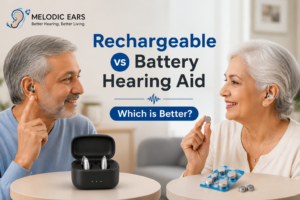
If you’re shopping for a hearing aid, you’ll hit this question early: rechargeable or battery-powered? Both work well. Both are used by millions of people every day. But they suit different lifestyles, budgets, and hands.
This guide is built to answer that question from every angle — cost, lifespan, convenience, care, real-life scenarios, and brand-by-brand differences — so you can make a confident choice, on your own or with your audiologist.
Explore related guides: 10 Types of Hearing Aids Explained: Which One is Right for You?
Quick Answer
Rechargeable hearing aids are generally the better choice for daily users because they eliminate battery replacements, reduce long-term costs, and are easier to manage. Battery-powered hearing aids remain a strong option for travellers and users without reliable access to charging.
Key Takeaways
- Rechargeable hearing aids use a built-in lithium-ion battery charged on a dock; battery hearing aids use small disposable zinc-air batteries.
- Rechargeable models typically run 18–30 hours per charge and fully charge in 3 hours or less.
- Disposable batteries last 3–20 days depending on size and hearing aid power draw.
- Over five and ten years, rechargeable hearing aids usually cost less to run, even though the upfront hearing aid price can be similar.
- Rechargeable hearing aids are generally easier for people with arthritis, tremors, or low vision.
- Battery hearing aids are easier to keep running during long power outages or off-grid travel.
- Globally, more than 1.5 billion people live with some degree of hearing loss, and over 430 million have disabling hearing loss that could benefit from a hearing aid, according to the World Health Organization.
- In the US, fewer than 1 in 4 adults who could benefit from a hearing aid actually use one, per NIDCD — so getting the fitting and power type right matters for long-term adherence.
- Both power types are available with Bluetooth streaming, water resistance, and premium sound processing.
- Always confirm the right choice with a licensed audiologist based on your hearing loss and lifestyle. Book a hearing test with Melodic Ears to get started.
Table of Contents
- What Are Rechargeable Hearing Aids?
- What Are Battery Hearing Aids?
- How Rechargeable Hearing Aids Work
- How Disposable Hearing Aid Batteries Work
- Rechargeable vs Battery Hearing Aids: Head to Head
- Feature Comparison Table
- Technology Comparison
- Advantages & Disadvantages
- Battery Life, Charging & Performance
- Bluetooth & Connectivity
- Water Resistance
- Cost, Running Cost & Ownership Calculator
- Environmental Impact
- Maintenance, Warranty & Repair
- Travel & Accessories
- Seniors & Dexterity
- Real-Life Buying Scenarios
- Decision Trees
- Best Brands (Full Breakdown)
- Product Recommendation Categories
- Myth vs Fact
- Troubleshooting
- Buying Guide & Buying Mistakes
- Research & Industry Statistics
- Who Should Buy Which
- Expert Tips Recap
- Future Trends
- Final Verdict
- Conclusion
- FAQs (40+)
1. What Are Rechargeable Hearing Aids?
Quick Answer: Rechargeable hearing aids have a sealed, built-in lithium-ion battery that powers the device for a full day and recharges overnight on a dock, removing the need to buy or insert disposable batteries.
Rechargeable hearing aids have a sealed, built-in lithium-ion battery instead of a replaceable disposable cell. You place the hearing aid on a charging dock each night, much like charging a phone or wireless earbuds, and it’s ready to wear again in the morning.
Did You Know? Most rechargeable hearing aid batteries are rated for 400–600 charge cycles, which typically works out to 3–6 years of daily use before the battery needs professional replacement.
2. What Are Battery Hearing Aids?
Quick Answer: Battery hearing aids run on small disposable zinc-air batteries in sizes 10, 13, 312, or 675, which you swap out every few days to a few weeks, with no charging required.
Battery hearing aids run on small disposable zinc-air batteries, sized 10, 13, 312, or 675. You open a battery door, drop in a fresh cell, and the hearing aid powers on. When the battery runs low, you simply replace it — no charging required. For a full breakdown of sizes, see our Hearing Aid Battery Sizes guide.
3. How Rechargeable Hearing Aids Work
Quick Answer: A rechargeable hearing aid stores power in a sealed lithium-ion cell, which is topped up by placing the device on a charging dock; most reach a full charge in under three hours and deliver a full day of use.
- The hearing aid contains a small lithium-ion cell sealed inside the casing.
- At night, you place both hearing aids into a charging case or dock.
- Contact pins or an induction coil transfer power into the battery.
- A full charge (usually 3 hours or less) typically powers the hearing aid for a full day, including several hours of Bluetooth streaming.
- Most chargers show battery status with LED lights, and many models offer a fast “quick charge” for 30–60 minutes of extra runtime in an emergency.
Expert Tip: Keep the charging dock plugged in overnight as a habit rather than waiting until the battery is nearly empty. This is gentler on lithium-ion cells than deep discharging.
4. How Disposable Hearing Aid Batteries Work
Quick Answer: Zinc-air batteries activate when a sticker tab is removed, exposing the cell to oxygen; once activated, they run continuously until they’re replaced, typically after 3 to 20 days depending on size.
- Zinc-air batteries have a sticker tab covering small air holes.
- Removing the tab exposes the battery to oxygen, which activates a chemical reaction that generates power.
- Once activated, the battery keeps working continuously — even when the hearing aid is off — so most users remove the battery at night instead of turning the device off.
- When volume drops or the device beeps a low-battery warning, you replace the cell with a fresh one.
Common Mistake: Removing the sticker tab and leaving the battery unused for more than a minute or two before inserting it wastes some of its charge, since the activation reaction has already begun.
5. Rechargeable vs Battery Hearing Aids: Head to Head
Quick Answer: The decision usually comes down to four questions: how much daily maintenance you’re willing to do, your budget structure, your hand dexterity, and how reliable your access to electricity is.
At a glance, the decision usually comes down to four questions:
- Do you want zero daily maintenance, or don’t mind a quick battery swap?
- Is your budget more comfortable with a small ongoing cost (batteries) or a slightly higher device price with lower running costs (rechargeable)?
- Do you have the dexterity to handle a tiny battery door and battery cell?
- Will you have reliable access to power for charging, including while travelling?
6. Feature Comparison Table
| Feature | Rechargeable Hearing Aids | Battery Hearing Aids |
| Power source | Built-in lithium-ion cell | Disposable zinc-air battery |
| Daily task | Place on charger overnight | Replace battery every few days |
| Typical runtime | 18–30 hours per charge | 3–20 days per battery |
| Charging time | 30 minutes to 3 hours | Not applicable |
| Handling difficulty | Low — no small parts to handle daily | Higher — small batteries and doors |
| Emergency backup | Needs a power source | Spare battery works anywhere |
| Cold weather performance | Slightly reduced runtime in extreme cold | Generally stable |
| Long-term running cost | Lower over 5–10 years | Higher over 5–10 years |
| Battery replacement | Every 3–6 years by a professional | Every few days by the user |
| Best for | Most users, especially those wanting convenience | Users with limited access to charging or very low dexterity needs |
7. Technology Comparison
| Aspect | Rechargeable | Battery |
| Cell chemistry | Lithium-ion (sealed) | Zinc-air (disposable) |
| Charge/replace cycle | 400–600 charge cycles per cell lifespan | Single-use, discarded after activation |
| Power management | Managed by internal charging circuit | No circuit — power drains continuously once activated |
| Device sealing | Often better-sealed against dust/moisture (fewer openings) | Battery door creates an additional opening |
| Firmware updates | Usually possible via app while charging or in use | Usually possible via app while in use |
8. Advantages & Disadvantages
Quick Answer: Rechargeable hearing aids win on convenience, long-term cost, and ease of handling; battery hearing aids win on power independence and simplicity for users without reliable charging access.
Advantages of Rechargeable Hearing Aids
- No tiny batteries to buy, carry, or fumble with.
- Predictable overnight routine, similar to charging a phone.
- Lower long-term running cost in most cases.
- Fewer moving parts exposed to moisture and earwax.
- Easier for people with arthritis, tremors, or vision difficulties.
- Many models offer quick-charge options for unexpected long days.
Advantages of Battery Hearing Aids
- No dependence on electricity — a spare battery works anywhere, anytime.
- Often a lower upfront device price on comparable models.
- Simple to understand and service, even in areas with limited technical support.
- No risk of forgetting to charge overnight.
- Battery compartment doubles as an on/off switch, which some users prefer.
Disadvantages of Rechargeable Hearing Aids
- Useless if you forget to charge them or lose access to power.
- The built-in battery isn’t user-replaceable; it needs professional service after a few years.
- Slightly higher upfront cost on some models.
- Charging case itself needs occasional cleaning and eventual replacement.
Disadvantages of Battery Hearing Aids
- Ongoing cost of buying batteries adds up over time.
- Small batteries are easy to drop or lose, and difficult for some users to insert.
- Batteries can die unexpectedly mid-day.
- Battery doors are a common point of mechanical wear and repair.
- Disposable batteries create more regular waste.
9. Battery Life, Charging & Performance
Quick Answer: Rechargeable hearing aids typically run 18–30 hours per charge and take under 3 hours to fully charge; disposable batteries last 3–20 days depending on size, and both types perform similarly in day-to-day sound quality.
Battery Life Comparison
| Power Type | Typical Runtime | Notes |
| Rechargeable (lithium-ion) | 18–30 hours per charge | Shorter with heavy Bluetooth streaming |
| Size 10 battery | 3–7 days | Smallest, used in tiny custom devices |
| Size 312 battery | 3–10 days | Common in RIC/BTE models |
| Size 13 battery | 6–14 days | Common in BTE models |
| Size 675 battery | 9–20 days | Used in high-power BTE models |
Charging Comparison
| Charging Method | Time to Full | Notes |
| Standard overnight charge | 2–3 hours | Typical daily routine |
| Fast/quick charge | 15–30 minutes | Provides several hours of backup use |
| Wireless charging case | 2–3 hours | Some cases also charge via power bank |
Performance & Sound Quality Comparison
| Aspect | Rechargeable | Battery |
| Sound processing quality | Depends on chip/tier, not power type | Depends on chip/tier, not power type |
| Fitting accuracy impact | Same — fitting matters more than power type | Same — fitting matters more than power type |
| Heavy Bluetooth use | Can shorten runtime notably | Can shorten battery life notably |
| Consistency of output | Very consistent until charge depletes | Gradual volume drop as battery nears end |
Common Mistake: Many buyers assume rechargeable hearing aids produce better sound. This is incorrect — sound quality depends primarily on the hearing aid’s processor, microphones, fitting, and programming, not on whether it uses rechargeable or disposable power.
10. Bluetooth & Connectivity
Quick Answer: Most modern hearing aids, rechargeable or battery, support Bluetooth streaming for calls, music, and TV audio; streaming draws more power in both formats, so heavy streamers should plan for a spare charge or spare battery.
| Aspect | Rechargeable | Battery |
| Bluetooth availability | Widely available on modern models | Widely available on modern models |
| Impact of streaming on power | Reduces daily runtime | Shortens battery lifespan |
| Backup for heavy streamers | Quick-charge or spare charging case | Spare battery pack |
Learn more in our dedicated Bluetooth Hearing Aids guide.
11. Water Resistance
Quick Answer: Water resistance is rated by IP code and depends on the specific model, not the power type — though rechargeable designs, with fewer external openings, are often easier to rate for higher resistance.
Water Resistance Comparison
| Aspect | Rechargeable | Battery |
| Typical design | Sealed casing, fewer openings | Battery door is an additional entry point |
| Common IP ratings available | Often IP68 on premium models | IP67–IP68 available on many premium models |
| Recommendation | Still avoid full submersion | Still avoid full submersion |
12. Cost, Running Cost & Ownership Calculator
Quick Answer: Rechargeable hearing aids typically cost less to run over five and ten years because there’s no repeat battery purchase, even though the upfront device price is often similar to battery models.
Running Cost Comparison
| Cost Factor | Rechargeable | Battery |
| Typical device price range | Comparable to, or slightly above, battery models | Comparable to, or slightly below, rechargeable models |
| Annual running cost | Near zero (electricity only) | Cost of batteries used through the year |
| Replacement part cost | Battery/charger service every few years | Ongoing battery purchases |
Hidden Costs Comparison
| Hidden Cost | Rechargeable | Battery |
| Charger replacement | Occasional, if damaged | Not applicable |
| Battery door repair | Not applicable | Possible after years of daily use |
| Travel adapters | May be needed internationally | Not needed |
| Disposal/recycling | End-of-life lithium-ion recycling | Ongoing battery recycling |
Five-Year Ownership Cost Example
| Line Item | Rechargeable Hearing Aid | Battery Hearing Aid |
| Device cost | Baseline device price | Baseline device price (often similar or slightly lower) |
| Annual running cost | Negligible electricity cost | Recurring battery purchases, once or twice weekly |
| Mid-cycle replacement | One internal battery/service replacement around year 3–5 | None required |
| Five-year total | Device price + one service replacement | Device price + five years of battery purchases |
Ten-Year Ownership Comparison
| Line Item | Rechargeable Hearing Aid | Battery Hearing Aid |
| Devices needed | Typically 1–2 devices across 10 years | Typically 1–2 devices across 10 years |
| Battery-related spend | One or two internal battery services | Roughly a decade of ongoing battery purchases |
| Overall pattern | Lower ongoing spend, more predictable | Higher cumulative ongoing spend |
These are illustrative ownership patterns, not fixed prices — always confirm current device and battery pricing with your audiologist or an authorized Melodic Ears dealer. Request a free consultation for a cost breakdown based on the exact models you’re considering.
13. Environmental Impact
Quick Answer: Disposable zinc-air batteries create ongoing waste and should be recycled properly, while rechargeable hearing aids reduce daily waste but still require responsible end-of-life disposal of the lithium-ion cell.
Environmental Comparison
| Aspect | Rechargeable | Battery |
| Daily waste | None | One battery every few days to weeks |
| End-of-life disposal | Lithium-ion recycling required | Zinc-air battery recycling required |
| Packaging waste | Minimal after purchase | Ongoing battery packaging |
14. Maintenance, Warranty & Repair
Quick Answer: Rechargeable hearing aids need less daily upkeep since there’s no battery to insert, but both types need regular cleaning, and both are typically covered by manufacturer warranties of similar length.
Maintenance Comparison
| Task | Rechargeable | Battery |
| Daily care | Wipe clean, place on charger | Wipe clean, check battery status |
| Weekly care | Clean charging contacts | Check battery door hinge |
| Ongoing purchases | None until battery service | Regular battery purchases |
| Professional service | Battery replacement every 3–6 years | Battery door repair if worn |
Maintenance Schedule Checklist
Daily – Wipe the hearing aid with a dry cloth. – Place rechargeable models on the charger; check battery status on battery models.
Weekly – Clean the microphone and receiver openings with a soft brush. – Wipe charging contacts (rechargeable) or the battery door (battery).
Monthly – Check domes, wax guards, or tubing for buildup and replace if needed. – Inspect the charging case or battery door for wear.
Every 6 Months – Have your audiologist perform a professional clean and check. – Review your hearing aid programming if your hearing or environment has changed.
Yearly – Book a full hearing test to track any changes in hearing. – Ask about firmware updates and battery health (for rechargeable models).
Warranty Comparison
| Aspect | Rechargeable | Battery |
| Typical manufacturer warranty | 1–3 years, varies by brand and tier | 1–3 years, varies by brand and tier |
| What’s usually covered | Device faults, sometimes battery performance | Device faults |
| What’s usually excluded | Physical damage, loss | Physical damage, loss |
Repair Comparison
| Issue | Rechargeable | Battery |
| Power-related fault | Battery/charger service by professional | Simply replace the battery |
| Common wear point | Charging contacts, charging case | Battery door hinge |
| DIY-fixable | Rarely | Often, for battery-related issues |
Accessory Comparison
| Accessory | Rechargeable | Battery |
| Charging case/dock | Required | Not applicable |
| Portable power bank | Optional, for travel | Not applicable |
| Spare batteries | Not applicable | Recommended to carry |
| Battery tester | Not applicable | Useful accessory |
| Dehumidifier/dry box | Recommended for both | Recommended for both |
15. Travel & Accessories
Quick Answer: For short trips with regular power access, rechargeable hearing aids are effortless; for remote travel or unreliable electricity, battery hearing aids offer a more dependable backup since spare batteries need no power source.
Travel Comparison
| Scenario | Better Fit |
| City trips, hotels with power | Rechargeable |
| Remote or off-grid travel | Battery |
| Long-haul flights | Either — carry a spare charge or spare batteries |
| Frequent short trips | Rechargeable, with a portable charger |
Expert Tip: If you travel internationally with rechargeable hearing aids, pack a universal plug adapter and consider a portable power bank compatible with your charging case.
Travel Checklist
- Confirm voltage/plug compatibility for your destination.
- Pack a spare charging cable or spare battery pack.
- Carry hearing aids and chargers in cabin baggage, not checked luggage.
- Bring a dry-storage case to protect against humidity.
- Note your nearest authorized service center at your destination for longer trips.
16. Seniors & Dexterity
Quick Answer: Rechargeable hearing aids are usually easier for seniors with arthritis, tremors, or low vision, since there’s no small battery to pinch and insert — though battery models still work well with caregiver support.
Senior Citizen Comparison
| Factor | Rechargeable | Battery |
| Ease of daily handling | Higher — just place on dock | Lower — requires fine motor control |
| Risk of losing small parts | Lower | Higher (small batteries) |
| Caregiver dependency | Lower | Can be higher without assistance |
| Routine predictability | High — same nightly habit | Depends on remembering to restock batteries |
For seniors with arthritis, tremors, or reduced fine motor control, rechargeable hearing aids are usually easier to manage day-to-day. Battery hearing aids can still work well for seniors who have a caregiver or family member available to help with battery changes.
17. Real-Life Buying Scenarios
Quick Answer: The right hearing aid type depends heavily on your daily routine — from age and dexterity to travel habits and streaming use — more than on price alone. The scenarios below map common situations to the better-fit option.
Scenario 1: “I’m 70 years old. Which hearing aid should I buy?”
Best option: Rechargeable Why: No small batteries to handle, and a simple nightly charging habit is easy to build. Pros: Low daily effort, fewer dropped batteries, easier for family members to help with. Possible drawbacks: Requires remembering to charge; a missed night means no hearing aid the next day.
Scenario 2: “I’m a frequent international traveller.”
Best option: Depends on destination — rechargeable for well-connected trips, battery for remote or unreliable-power destinations. Why: Rechargeable needs power access; battery needs no power at all. Pros of rechargeable: No batteries to carry through customs or airport security concerns. Pros of battery: Works anywhere, instantly, with a spare pack. Possible drawbacks: Rechargeable can leave you stranded without power; battery means carrying spares.
Scenario 3: “I work in an office.”
Best option: Rechargeable Why: Reliable daily power access at home and desk charging options make the overnight routine effortless. Pros: Predictable all-day battery life for meetings and calls. Possible drawbacks: None significant in a typical office setting.
Scenario 4: “I stream music every day.”
Best option: Rechargeable, ideally a model with quick-charge support. Why: Streaming drains power faster in both formats, but rechargeable quick-charge features offer a fast top-up. Pros: No recurring battery cost despite heavy streaming use. Possible drawbacks: Heavy streaming days may need a midday top-up charge.
Scenario 5: “I have arthritis.”
Best option: Rechargeable Why: No small battery or battery door to manipulate with painful or limited-mobility hands. Pros: Simple drop-into-the-dock routine. Possible drawbacks: None significant, aside from remembering to charge nightly.
Scenario 6: “I’m buying hearing aids for my parents.”
Best option: Rechargeable, unless a caregiver is available daily to manage batteries. Why: Reduces the risk of a parent forgetting or struggling with battery changes. Pros: Easier to monitor remotely — a missed charge is easy to notice and remind about. Possible drawbacks: Requires ensuring reliable power access in their home.
Scenario 7: “I live in a rural area.”
Best option: Battery, if power supply is inconsistent; rechargeable if power is reliable. Why: Battery hearing aids don’t depend on the grid at all. Pros of battery: Unaffected by power cuts. Pros of rechargeable: Lower running cost if power is reliable. Possible drawbacks: Battery requires a steady local supply of the right battery size.
Scenario 8: “I wear hearing aids more than 14 hours daily.”
Best option: Rechargeable with quick-charge support, or battery with a spare on hand. Why: Both need a plan for long days; rechargeable quick-charge and battery spares solve this differently. Pros of rechargeable: A short top-up charge can extend a long day. Pros of battery: A spare battery instantly resets your runtime. Possible drawbacks: Rechargeable needs access to a charger mid-day; battery means carrying spares everywhere.
18. Decision Trees
Quick Answer: Choose rechargeable if you value convenience, low running costs, and have reliable power access; choose battery if you prioritize power independence, travel to areas with unreliable electricity, or prefer replaceable parts.
Decision Tree 1: General Choice
Choose Rechargeable if: ✅ You wear hearing aids daily ✅ You dislike changing batteries ✅ You have arthritis or dexterity challenges ✅ You use Bluetooth frequently ✅ You have reliable access to power overnight
Choose Battery if: ✅ You travel often to areas with unreliable electricity ✅ You don’t always have access to power ✅ You prefer replaceable, swappable parts ✅ You want instant backup power without charging
Decision Tree 2: Budget-Focused
Choose Rechargeable if: ✅ You want predictable, low running costs over 5–10 years ✅ You’re comfortable with a slightly higher device price for long-term savings
Choose Battery if: ✅ You want the lowest possible upfront device price on certain models ✅ You’d rather pay small, ongoing costs than a bigger one-time cost
Decision Tree 3: Lifestyle-Focused
Choose Rechargeable if: ✅ Your daily routine includes a stable overnight base (home, hotel, office) ✅ You want a “set it and forget it” power routine
Choose Battery if: ✅ Your lifestyle is unpredictable or off-grid ✅ You want zero dependency on charging infrastructure
Explore rechargeable hearing aids or compare hearing aid styles to see which fits your decision tree result.
19. Best Brands (Full Breakdown)
Quick Answer: Phonak, Signia, Starkey, Widex, Oticon, ReSound, Unitron, and Rexton all offer both rechargeable and battery models across entry-level to premium tiers — the right brand depends on your priorities around connectivity, sound processing, and budget.
Phonak
Overview: A major hearing aid manufacturer known for strong wireless connectivity and reliable rechargeable platforms. Best Rechargeable Models: Premium and mid-tier rechargeable receiver-in-canal (RIC) models with lithium-ion platforms. Best Battery Models: Behind-the-ear (BTE) models in standard battery sizes for users needing longer runtime per cell. Who Should Buy: Users who prioritize connectivity and consistent everyday performance. Key Features: Strong Bluetooth streaming, app-based control, wide power range. Pros: Reliable performance, broad product range across styles. Cons: Premium tiers carry a premium price. Technology Highlights: Focus on hands-free calling and multi-device connectivity.
Signia
Overview: Offers both rechargeable and battery ranges with a strong focus on speech-in-noise processing. Best Rechargeable Models: RIC and BTE rechargeable models aimed at active, social users. Best Battery Models: Traditional BTE battery models for users prioritizing maximum runtime. Who Should Buy: Users who spend a lot of time in noisy or social environments. Key Features: Own Voice Processing and speech clarity technology. Pros: Strong performance in group conversations. Cons: Some advanced features are limited to premium tiers. Technology Highlights: Dual-processing paths for own voice vs external sound.
Starkey
Overview: A US-based manufacturer known for rechargeable models with added health-tracking sensor features. Best Rechargeable Models: Premium rechargeable RIC models with fall-detection and activity tracking. Best Battery Models: Standard BTE battery models for users who want simplicity. Who Should Buy: Users interested in health and wellness tracking alongside hearing support. Key Features: Built-in sensors, translation features on select models. Pros: Extra health features beyond hearing. Cons: Sensor features may be unnecessary for some users. Technology Highlights: Integration of hearing and general wellness monitoring.
Widex
Overview: Known for natural, low-distortion sound processing across both power types. Best Rechargeable Models: Premium rechargeable RIC models focused on sound naturalness. Best Battery Models: BTE and custom battery models for users prioritizing runtime. Who Should Buy: Users who are sensitive to sound distortion or prefer a more natural listening experience. Key Features: Fast sound processing to reduce delay (“latency”). Pros: Natural sound quality often praised by long-time users. Cons: App ecosystem varies by region. Technology Highlights: Focus on minimizing processing delay for a more natural feel.
Oticon
Overview: Strong rechargeable lineup built around deep neural network sound processing. Best Rechargeable Models: Premium rechargeable RIC models using AI-based sound processing. Best Battery Models: BTE battery models for users needing extended runtime. Who Should Buy: Users who want the brain to work less to process complex sound environments. Key Features: Deep neural network processing trained to prioritize speech. Pros: Strong performance in complex listening environments. Cons: Premium processing is concentrated in higher tiers. Technology Highlights: AI-based scene analysis and sound balancing.
ReSound
Overview: Offers a wide range of rechargeable and battery models with strong smartphone app control. Best Rechargeable Models: RIC rechargeable models with extensive app customization. Best Battery Models: BTE battery models for users who want simple, dependable performance. Who Should Buy: Users who want fine-grained control via a smartphone app. Key Features: Wide compatibility with smartphone streaming. Pros: Strong app ecosystem and personalization options. Cons: Full feature set typically requires a compatible smartphone. Technology Highlights: Direct streaming compatibility with a broad range of devices.
Unitron
Overview: Known for flexible fitting options across both power types. Best Rechargeable Models: Mid-tier rechargeable RIC models with flexible fitting software. Best Battery Models: BTE battery models for straightforward, dependable use. Who Should Buy: Users who want a more customizable fitting process with their audiologist. Key Features: Flexible fitting software and remote adjustment options. Pros: Good balance of features and value. Cons: Less brand recognition than some competitors. Technology Highlights: Emphasis on remote fine-tuning between visits.
Rexton
Overview: A value-focused brand offering both rechargeable and battery models. Best Rechargeable Models: Entry to mid-tier rechargeable RIC models. Best Battery Models: Entry-level BTE battery models. Who Should Buy: Budget-conscious users who still want reliable core performance. Key Features: Core hearing aid functionality at accessible price points. Pros: More affordable across the range. Cons: Fewer premium features than flagship brands. Technology Highlights: Focus on essential, dependable hearing support at lower price points.
Brand Comparison Table
| Brand | Rechargeable Available | Battery Available | Known For |
| Phonak | Yes | Yes | Connectivity, reliability |
| Signia | Yes | Yes | Speech-in-noise processing |
| Starkey | Yes | Yes | Health sensor features |
| Widex | Yes | Yes | Natural sound quality |
| Oticon | Yes | Yes | Deep neural sound processing |
| ReSound | Yes | Yes | App control, wide range |
| Unitron | Yes | Yes | Flexible fittings |
| Rexton | Yes | Yes | Value pricing |
Exact model availability and specifications change over time — confirm current options with your audiologist or an authorized Melodic Ears dealer. See our Best Hearing Aid Brands guide for more.
20. Product Recommendation Categories
Quick Answer: Rather than naming specific unverified models, the categories below point you to the right conversation with your audiologist based on what you value most — budget, premium features, senior-friendly design, or Bluetooth performance.
Because exact model line-ups and specifications change frequently across brands, we recommend confirming current best-in-category models directly with your audiologist or an authorized Melodic Ears dealer. Use these categories to guide that conversation:
- Best Rechargeable Hearing Aid Overall: Ask for a premium rechargeable RIC model from a major brand with strong reviews for your specific hearing loss level.
- Best Budget Rechargeable: Ask about entry-tier rechargeable models, which still include core lithium-ion convenience without premium extras.
- Best Premium Rechargeable: Ask about flagship rechargeable models with AI-based sound processing and extended Bluetooth features.
- Best Rechargeable for Seniors: Ask about models with simplified controls, easy-to-use charging cases, and larger, easy-to-grip designs.
- Best Rechargeable for Bluetooth: Ask about models specifically rated for extended streaming battery life.
- Best Battery Hearing Aid: Ask about BTE models in size 13 or 675 for maximum runtime per battery.
- Best Battery Hearing Aid for Travel: Ask about models with the longest battery life per cell to minimize how often you need spares.
- Best Value Hearing Aid: Ask your audiologist which mid-tier model offers the best feature set for your budget and hearing profile.
21. Myth vs Fact
Quick Answer: Common misconceptions — like rechargeable meaning better sound, or battery hearing aids being outdated — don’t hold up to how these devices actually work; power type and sound quality are separate features.
Myth: Rechargeable hearing aids have better sound quality. Fact: Sound quality depends primarily on the hearing aid’s processor, microphones, fitting, and programming — not on whether it uses rechargeable or disposable batteries.
Myth: Battery hearing aids are outdated. Fact: Battery hearing aids remain widely manufactured and sold, and are still the better choice for users without reliable power access or those who prefer replaceable parts.
Myth: Rechargeable hearing aids cannot be repaired. Fact: Rechargeable hearing aids can be repaired and serviced, including professional replacement of the internal battery, typically every 3–6 years.
Myth: Battery hearing aids are always cheaper. Fact: Upfront device prices can be similar or even lower for battery models, but ongoing battery purchases often make rechargeable cheaper in total cost over five to ten years.
Myth: Rechargeable batteries stop working after one year. Fact: Most rechargeable hearing aid batteries are rated for 400–600 charge cycles, typically lasting 3–6 years of daily use before professional replacement is needed.
Myth: You can’t use rechargeable hearing aids while travelling. Fact: Rechargeable hearing aids travel well with a plug adapter and, if needed, a portable power bank compatible with the charging case.
22. Troubleshooting
Quick Answer: Most rechargeable hearing aid problems trace back to dirty charging contacts, an aging battery, or moisture; most battery hearing aid problems trace back to a weak or incorrectly inserted battery.
Why won’t my rechargeable hearing aid charge? Check that the charging contacts on both the hearing aid and dock are clean and dry, and confirm the charger is properly plugged in. If cleaning doesn’t help, the internal battery may need professional evaluation.
Battery draining quickly (rechargeable): Heavy Bluetooth streaming, an aging battery nearing the end of its charge-cycle life, or cold weather can all shorten daily runtime. Ask your audiologist to check battery health if this happens suddenly.
Charging dock not working: Try a different power outlet or cable, and check for visible damage to the contacts. If the issue persists, the dock itself may need replacement.
Battery dies early (disposable): This is often due to a low-quality or expired battery, or a battery that’s been exposed to air for too long before insertion. Try a fresh battery from a sealed pack.
Bluetooth reduces battery life: This is expected behavior on both power types — streaming draws more power than standard amplification. Plan for a quick recharge or spare battery on heavy streaming days.
Cold weather issues: Both battery types can be affected by extreme cold, with rechargeable batteries showing a modest runtime dip and zinc-air batteries sometimes draining faster in freezing conditions.
Moisture problems: Store hearing aids in a dry-storage case or dehumidifier overnight, especially in humid climates, and avoid wearing them while swimming or showering unless rated for it.
23. Buying Guide & Buying Mistakes
Quick Answer: The best buying process starts with a professional hearing test, followed by comparing power types and technology tiers against your lifestyle — not choosing by price alone or skipping a proper fitting.
Buying Guide
- Get a professional hearing test to understand your hearing loss level.
- Discuss your daily routine, travel habits, and dexterity with your audiologist.
- Compare rechargeable and battery models within your preferred technology tier.
- Ask about real-world battery life and charging time for the specific model.
- Check water resistance and Bluetooth features if relevant to your lifestyle.
- Confirm warranty, trial period, and after-sales battery/charger service.
- Try both types during a trial period before committing, if possible.
Buying Checklist
- ☐ Hearing test completed with a licensed audiologist
- ☐ Power type (rechargeable or battery) discussed against your lifestyle
- ☐ Technology tier matched to your hearing loss and budget
- ☐ Water resistance rating checked
- ☐ Bluetooth/streaming needs discussed
- ☐ Warranty and trial period confirmed
- ☐ After-sales service location confirmed
Common Buying Mistakes
Common Mistake: Buying without a hearing test — hearing aids should be matched to your specific hearing loss profile, not chosen off the shelf.
Common Mistake: Choosing based on price alone without factoring in five- to ten-year running costs.
Common Mistake: Ignoring warranty terms and after-sales service availability.
Common Mistake: Buying online without a professional fitting, which can undermine sound quality regardless of power type.
Common Mistake: Picking rechargeable without considering how reliable your access to power will be while travelling.
Common Mistake: Ignoring realistic battery replacement costs when comparing “cheaper” battery models.
Common Mistake: Ignoring your actual Bluetooth/streaming habits, which affect real-world runtime on both power types.
Common Mistake: Assuming battery hearing aids are outdated — they remain a solid, dependable choice for many users.
Download our buying checklist or book a hearing test to start the process with a professional.
24. Research & Industry Statistics
Quick Answer: Hearing loss affects more than 1.5 billion people globally, yet fewer than 1 in 4 adults who could benefit from a hearing aid actually use one — underscoring how important a comfortable, sustainable power type is for long-term use.
- The World Health Organization estimates that more than 1.5 billion people worldwide live with some degree of hearing loss, with over 430 million experiencing disabling hearing loss that could benefit from hearing aids and rehabilitation services.
- WHO projects that the number of people with disabling hearing loss could rise toward 700 million by 2050 as populations age.
- In the United States, the National Institute on Deafness and Other Communication Disorders (NIDCD) estimates that about 28.8 million adults could benefit from using hearing aids.
- Fewer than 1 in 4 US adults who could benefit from hearing aids has ever used one, according to NIDCD data — and usage is lowest among younger adults with hearing loss.
- Among US adults aged 70 and older who could benefit from hearing aids, fewer than 1 in 3 has ever used them, per NIDCD.
- People often wait years after a hearing loss diagnosis before getting their first hearing aid, according to research cited by the Hearing Loss Association of America — a gap that highlights the importance of choosing a device (and a power type) you’ll actually wear consistently.
- Rechargeable hearing aid adoption has grown significantly across the industry in recent years as lithium-ion technology has become smaller, cheaper, and longer-lasting, though exact market-share figures vary by source and year.
These statistics are cited from WHO and NIDCD publications and are current as of the most recently published figures at the time of writing. Always check the original sources for the latest updates.
25. Who Should Buy Which
Quick Answer: Rechargeable suits most daily users with reliable power access; battery suits travellers to low-power areas, users who prefer replaceable parts, or those without a consistent charging routine.
Who Should Buy Rechargeable Hearing Aids?
Rechargeable is a strong fit if you want a simple daily routine, have reliable access to power overnight, want lower long-term running costs, or have dexterity challenges that make handling small batteries difficult.
Who Should Buy Battery Hearing Aids?
Battery hearing aids suit you if you travel frequently to areas with unreliable electricity, prefer not to worry about charging schedules, want the flexibility of swapping in a spare battery instantly, or are comfortable handling small batteries daily.
26. Expert Tips Recap
Expert Tip: Audiologists generally recommend rechargeable hearing aids for people who wear hearing aids every day, because they simplify maintenance and reduce handling of small batteries.
Expert Tip: Keep a spare charged battery or backup charging case as insurance, whichever power type you choose.
Expert Tip: Clean charging contacts and battery doors weekly with a dry brush to prevent connectivity issues.
Expert Tip: Ask your audiologist about the specific charge-cycle rating of a rechargeable model before buying — higher-end models tend to hold capacity longer.
27. Future Trends
Quick Answer: Rechargeable technology continues to improve with faster charging and longer runtime, and is steadily becoming the default recommendation for new buyers, though battery hearing aids remain in production for users who need power independence.
Rechargeable technology continues to improve, with faster charging, longer daily runtime, and smaller charging cases becoming standard across more price tiers. Battery hearing aids aren’t disappearing, but rechargeable models are steadily becoming the default recommendation for new buyers, especially as lithium-ion costs fall and charge cycles improve.
28. Final Verdict
For most people in 2026, rechargeable hearing aids offer the better balance of convenience and long-term cost. Battery hearing aids remain a dependable, sensible choice for specific situations — particularly unreliable power access or very limited hand dexterity without caregiver support. The right choice depends on your lifestyle, budget, and hearing needs, so a conversation with a licensed audiologist is the best next step.
29. Conclusion
Both rechargeable and battery hearing aids can deliver excellent hearing performance — the power source is really a lifestyle decision, not a hearing quality one. Think through your daily routine, travel habits, and hand dexterity, compare a few models across both types, and get a professional fitting to make sure whichever you choose works well for your ears and your life. Hearing aid performance depends heavily on fitting, programming, and follow-up care — not the device alone — so professional support matters regardless of which power type you choose.
Talk to an audiologist or book a hearing test with Melodic Ears to get personalized guidance.
Frequently Asked Questions
Which hearing aid is best, rechargeable or battery?
For most everyday users, rechargeable hearing aids are the better overall choice due to lower long-term cost and easier daily use. Battery hearing aids remain the better fit for specific situations, like unreliable power access.
Are rechargeable hearing aids better than batteries?
They’re better for most people in terms of convenience and running cost, but “better” depends on your travel habits, dexterity, and budget.
What is the disadvantage of rechargeable hearing aids?
The main disadvantage is dependence on a power source — if you forget to charge or lose access to electricity, the hearing aid can’t be quickly revived with a spare part the way a battery model can.
How long will rechargeable hearing aids last?
The built-in battery typically lasts 3–6 years of daily use before needing professional replacement, while the hearing aid device itself often lasts 5–7 years or more.
Can rechargeable hearing aids be repaired?
Yes. Most issues, including battery replacement, can be handled by an authorized service center or your audiologist.
Can rechargeable hearing aids be used while travelling?
Yes, as long as you have access to power to charge them overnight. Pack a plug adapter for international travel.
Can rechargeable hearing aids be used on flights?
Yes, they’re safe to use on flights. Charging cases with batteries should follow standard airline carry-on battery guidelines.
What happens if rechargeable hearing aids run out of battery?
They stop working until recharged. A portable power bank or backup charging case can help in emergencies.
Can rechargeable hearing aid batteries be replaced?
Yes, but not by the user — the built-in battery is replaced by a professional, typically every 3–6 years.
Do rechargeable hearing aids lose capacity over time?
Yes, like any lithium-ion battery, capacity gradually declines with charge cycles, which is why periodic professional replacement is needed.
Are rechargeable hearing aids waterproof?
Water resistance varies by model and is rated separately from power type — check the specific IP rating before buying.
Which hearing aid is best for senior citizens?
Rechargeable hearing aids are often easier for seniors with arthritis or tremors, since there’s no small battery to handle daily.
Which hearing aid lasts the longest?
The hearing aid device itself lasts a similar number of years regardless of power type; the difference is in how the power source is maintained.
Which hearing aid saves more money over five years?
Rechargeable hearing aids typically save money over five years due to lower ongoing running costs.
Which hearing aid saves more money over ten years?
The gap generally widens over ten years, since battery purchases continue to accumulate while rechargeable running costs stay low.
Are rechargeable hearing aids worth buying?
For most users, yes — the convenience and lower running cost make them a strong default choice.
Do rechargeable hearing aids have Bluetooth?
Most modern rechargeable hearing aids include Bluetooth streaming for calls, music, and TV audio.
Are battery hearing aids becoming obsolete?
No, they remain widely available and are still the better choice for some users, particularly those with limited power access.
Which hearing aid is easier to maintain?
Rechargeable hearing aids generally require less daily maintenance since there’s no battery to buy or insert.
Can hearing aid batteries be recycled?
Yes, disposable zinc-air batteries should be recycled through battery-recycling programs rather than regular trash.
What size batteries do hearing aids use?
Common disposable sizes are 10, 13, 312, and 675, each color-coded for easy identification.
How often do hearing aid batteries need replacing?
Disposable batteries typically last 3–20 days depending on size and hearing aid power draw.
Are rechargeable hearing aids safe to charge overnight?
Yes, charging docks are designed for safe overnight charging, similar to a phone charger.
Can I carry hearing aid chargers on an airplane?
Yes, hearing aid chargers and their batteries are permitted in carry-on luggage under standard airline rules.
Which hearing aid performs better in cold weather?
Disposable batteries tend to be slightly more stable in cold conditions, while rechargeable batteries can show modest runtime reduction in extreme cold.
Which hearing aid is better for frequent travellers?
It depends on destination reliability of power — frequent travellers to areas with unreliable electricity may prefer battery hearing aids, while those with steady access to power outlets often prefer rechargeable.
Which hearing aid is better for people with arthritis?
Rechargeable hearing aids are generally easier for people with arthritis, since there’s no small battery to grip and insert.
Are rechargeable hearing aids environmentally friendly?
They generally produce less ongoing waste than disposable batteries, though the lithium-ion cell still needs proper end-of-life recycling.
Which brands offer the best rechargeable hearing aids?
Phonak, Signia, Starkey, Widex, Oticon, ReSound, Unitron, and Rexton all offer well-regarded rechargeable models.
How do I know which hearing aid is right for me?
A professional hearing test and a conversation with your audiologist about your lifestyle, budget, and dexterity is the most reliable way to decide.
Should I consult an audiologist before buying a hearing aid?
Yes. An audiologist can confirm your hearing loss profile and recommend the power type and technology tier best suited to your needs.
Are rechargeable hearing aid batteries safe?
Yes, they use the same lithium-ion technology found in phones and are designed with safety circuits for everyday charging.
Do children’s hearing aids come in rechargeable versions?
Yes, though many pediatric hearing aids still use disposable batteries, partly because battery status is easy for caregivers to monitor and swap quickly.
Does insurance cover rechargeable hearing aids?
Coverage varies widely by insurer, plan, and country — check with your provider and your audiologist’s clinic about what’s included.
How much does it cost to replace a rechargeable hearing aid battery?
Costs vary by brand and service provider; ask your audiologist for a quote specific to your model.
Can I switch from battery to rechargeable hearing aids?
Generally yes, though it usually means purchasing a new hearing aid rather than converting an existing battery model.
Do rechargeable hearing aids work if the power goes out?
They’ll keep working on their existing charge, but you won’t be able to recharge them until power returns — a portable power bank can help bridge a gap.
Is it normal for a rechargeable hearing aid to feel warm while charging?
A little warmth is normal, similar to charging a phone; excessive heat should be checked by your audiologist.
Can I use third-party batteries in my battery hearing aid?
Reputable third-party zinc-air batteries in the correct size generally work, but manufacturer-recommended batteries are the safest choice for consistent performance.
What’s the difference between size 13 and size 312 batteries?
Size 13 batteries are larger and generally last longer per battery than size 312, which is more common in smaller receiver-in-canal devices.
How long does it take to get used to a new hearing aid?
Adjustment periods vary, but most people adapt within a few weeks with the help of follow-up appointments with their audiologist.
Should I buy the same power type as my last hearing aid?
Not necessarily — it’s worth reassessing your lifestyle and dexterity each time you upgrade, since your needs may have changed.

Pingback: What Is Tinnitus? Causes, Treatment & Hearing Aid Solutions