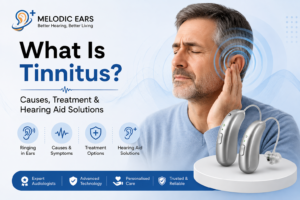
Have you ever noticed a ringing sound in your ears when there is no phone ringing, machine running or other obvious source of noise nearby? You may be experiencing tinnitus.
Tinnitus is the name given to sounds that a person hears without an external sound producing them. Ringing is the sound people mention most often, but tinnitus can also feel like buzzing, humming, hissing, clicking, roaring or even a pulsing sound. It may affect one ear, both ears or seem to come from inside the head.
For some people, tinnitus is occasional and easy to ignore. For others, it can become difficult to live with, particularly when it affects sleep, concentration, conversations or mood.
Tinnitus is not a disease by itself. It is usually a symptom associated with another condition, with hearing loss being one of the most common associations. The cause is not always obvious, which is why understanding the pattern of your tinnitus and getting your hearing checked can be useful.
This guide explains what tinnitus is, what can cause it, how it is evaluated, which treatments may help and when hearing aids can be useful.
Important: Tinnitus can have many causes. This article is for general information and does not replace an evaluation by an ENT specialist or hearing professional.
What Is Tinnitus?
Tinnitus is the perception of a sound when there is no corresponding sound coming from outside the body.
Imagine sitting in a quiet bedroom and suddenly noticing a high pitched ringing. You check your phone. Nothing is playing. You move to another room and the sound is still there.
That is the basic experience of tinnitus.
The sound is real to the person experiencing it, even though someone sitting beside them usually cannot hear it. Tinnitus can happen in one ear, both ears or somewhere that feels difficult to locate. It may be present throughout the day or appear only at certain times.
The sound itself can be very different from one person to another.
Some people describe:
- Ringing
- Buzzing
- Hissing
- Humming
- Clicking
- Roaring
- Whistling
- Whooshing
- A pulsing sound that follows the heartbeat
The volume can also vary. For one person, tinnitus may be a faint background noise. For another, it may be loud enough to interfere with sleep or concentration.
One important point is that tinnitus does not automatically mean that you have hearing loss. However, hearing loss and tinnitus frequently occur together, so a hearing evaluation can be an important part of understanding what is happening.
Also Read – CIC Hearing Aids: Price in India, Benefits, Types & Complete Guide
What Does Tinnitus Sound Like?
There is no single sound that defines tinnitus.
You might hear a high pitched tone similar to an electronic beep. Someone else may hear a low humming noise. Another person may describe a sound similar to wind, static or an electrical buzz.
| Tinnitus sound | How it may feel |
|---|---|
| Ringing | A continuous or intermittent high pitched tone |
| Buzzing | Similar to an electrical or vibrating sound |
| Hissing | A sound resembling air or static |
| Humming | A deeper, low frequency sound |
| Clicking | Repeated clicks that may occur at regular intervals |
| Roaring | A deeper sound similar to distant machinery |
| Whooshing | A flowing or rushing sound |
| Pulsing | A rhythm that may seem to follow the heartbeat |
The type of sound can sometimes provide useful information to a healthcare professional, but you should not try to diagnose the cause based on the sound alone.
For example, clicking may sometimes be associated with muscle activity around the ear, while pulsing sounds can have a connection with blood flow. Your medical history and examination are more important than simply matching your sound to a list.
Also Read – Rechargeable Hearing Aids vs Battery: Which Is Better?
Types of Tinnitus
Tinnitus is commonly divided into subjective and objective tinnitus.
Subjective tinnitus
This is the more common form.
Only the person experiencing tinnitus can hear the sound. It may be related to hearing loss, noise exposure, ear conditions, medications or other changes affecting the hearing system.
Objective tinnitus
Objective tinnitus is much less common.
In some cases, a healthcare professional may also be able to detect the sound during an examination. It can sometimes be associated with a specific physical cause that may be identifiable and treatable.
Pulsatile tinnitus
Pulsatile tinnitus deserves special attention.
Instead of hearing a continuous ringing or buzzing, a person may hear a rhythmic sound that seems to beat in time with their heartbeat. This can sometimes be related to blood flow or other physical conditions. Depending on the symptoms, a doctor may recommend additional evaluation or imaging.
If you regularly hear a new pulsing sound in your ear, particularly if it is only on one side, it is worth discussing with a healthcare professional rather than assuming it is ordinary tinnitus.
Also Read – Invisible Hearing Aids Guide (2026): Price, Reviews, Pros & Cons & Buying Guide
What Causes Tinnitus?
There are many possible causes of tinnitus. Sometimes a clear cause can be found. In other cases, even after evaluation, there may not be one obvious explanation.
Hearing loss
Hearing loss is one of the most important conditions associated with tinnitus.
The cochlea in the inner ear contains tiny sensory cells that help convert sound vibrations into signals that travel through the auditory system to the brain. Ageing and repeated exposure to loud sounds can damage these delicate structures.
When hearing changes, the brain receives different information from the ears. Tinnitus can occur alongside these changes.
This is one reason someone can have tinnitus without realizing that they also have hearing loss.
You may still hear people talking. You may still be able to watch television. You may even feel that your hearing is normal.
But you might notice that conversations in restaurants are becoming harder, people seem to mumble, or you keep increasing the television volume.
Loud noise exposure
A very loud sound can trigger tinnitus.
Examples include concerts, fireworks, industrial machinery, construction equipment and other environments with high noise levels.
Repeated exposure can also contribute to hearing damage and tinnitus over time. Protecting your hearing is therefore important, particularly if you regularly work or spend time around loud sounds.
Earwax blockage
A buildup of earwax can block the ear canal and affect how sound reaches the ear.
In some people, removing an excessive blockage under professional guidance can improve tinnitus symptoms. If you suspect earwax is responsible, avoid putting objects deep inside the ear to remove it yourself.
Ear infections and other ear problems
Ear infections and other conditions affecting the ear can temporarily change hearing and contribute to tinnitus.
The appropriate treatment depends on the underlying problem.
Medicines
Some medicines can cause or worsen tinnitus in certain people.
The possibility depends on the medicine, dose and individual circumstances. If you think a medicine may be affecting your tinnitus, do not stop taking it on your own. Speak with the healthcare professional who prescribed it.
Head or neck injuries
An injury involving the head or neck can sometimes be associated with tinnitus. This may happen because the injury affects structures involved in hearing or the way the nervous system processes sound.
Jaw and TMJ problems
Problems involving the jaw joint can sometimes be connected with tinnitus.
Some people notice that the tinnitus changes when they clench their jaw, move the jaw or experience jaw discomfort. This can be useful information to mention during an evaluation.
Ménière’s disease and other ear conditions
Tinnitus can occur alongside certain inner ear conditions, including Ménière’s disease.
These conditions may also involve other symptoms such as hearing changes, dizziness or a feeling of fullness in the ear.
Blood vessel related causes
Some tinnitus sounds are connected with changes in blood flow around the ear and head.
This is particularly relevant when the sound is rhythmic or seems to follow the heartbeat. Such symptoms deserve appropriate medical assessment.
Also Read- Best Hearing Aid in India 2026 -Top 10 Picks by Audiologists
Is Tinnitus a Sign of Hearing Loss?
Not necessarily.
A person can have tinnitus without obvious hearing loss. At the same time, hearing loss is very commonly associated with tinnitus.
This relationship is one reason a hearing test can be useful when someone develops persistent ringing or other unexplained sounds.
You may have hearing loss without realizing it. Early hearing changes can be subtle. You may notice them first in situations where there is background noise rather than in a quiet room.
Some common clues include:
- Asking people to repeat themselves
- Increasing the television volume
- Difficulty following conversations in restaurants
- Struggling to hear children or soft voices
- Finding it difficult to understand speech when several people are talking
- Feeling that people are speaking unclearly
If you have tinnitus along with any of these signs, consider getting your hearing evaluated.
A hearing test does not tell you the cause of every case of tinnitus, but it can show whether hearing loss is present and help a hearing professional understand your hearing profile.
Also Read- 10 Types of Hearing Aids Explained: Which One is Right for You?
How Is Tinnitus Diagnosed?
Tinnitus itself is usually identified from what you describe.
The more important question is often:
Why is this happening?
A healthcare professional may ask:
- When did the tinnitus begin?
- Is it in one ear or both?
- Is it constant or does it come and go?
- What does the sound resemble?
- Does it seem to follow your heartbeat?
- Has your hearing changed?
- Have you recently been around loud noise?
- Have you experienced an ear infection or injury?
- Are you taking any medicines that could be relevant?
- Does moving your jaw or neck change the sound?
Your ears, head and neck may also be examined.
Hearing test
A hearing test, also called an audiological evaluation, is commonly used when tinnitus is being assessed.
It can identify the type and degree of hearing loss and provide information that may help guide the next step.
Other tests
Additional tests are not necessary for everyone.
Depending on your symptoms and the suspected cause, a doctor may recommend tests such as tympanometry, blood tests or imaging.
For example, imaging may be considered when there are particular symptoms such as pulsatile tinnitus or other findings that need further investigation.
Tinnitus Treatment: Can It Be Cured?
There is no single treatment that makes tinnitus disappear for everyone.
The right approach depends on the cause and on how much the tinnitus is affecting your daily life.
Sometimes treating the underlying problem can reduce or even resolve the tinnitus. For example, treating an earwax blockage may help when the blockage is contributing to the symptoms. In other cases, tinnitus may continue and the focus becomes reducing how noticeable and disruptive it is.
Treating the underlying cause
If an identifiable cause is found, treatment can be directed toward that condition.
This could include professional removal of an earwax blockage, treatment of an ear infection, management of a relevant medical condition or discussion about a medicine that may be contributing to the symptoms.
Sound therapy
Sound can sometimes make tinnitus less noticeable.
A completely silent room can make an internal sound seem much louder. Gentle background sound may give your attention something else to focus on.
Some people use:
- A fan
- Soft music
- Nature sounds
- Rain sounds
- A white noise device
- Sound generating applications
The goal is not necessarily to drown out tinnitus completely. For some people, a softer background sound simply makes the tinnitus less prominent.
Cognitive behavioural therapy
Cognitive behavioural therapy, commonly called CBT, can help people change how they respond to tinnitus.
It does not mean that tinnitus is imaginary.
The tinnitus is real. CBT focuses on the distress, thoughts and emotional reactions that can develop around the sound.
This can be particularly useful when tinnitus is affecting sleep, concentration, anxiety or overall quality of life.
Tinnitus retraining approaches
Tinnitus retraining approaches combine education, counselling and sound based strategies.
The broader idea is to help the brain treat tinnitus as a less important sound so that you gradually pay less attention to it.
Results vary from person to person, and treatment should be discussed with an appropriately trained professional.
Medicines and supplements
There is currently no medicine that universally cures tinnitus.
Medicines may sometimes be prescribed for associated problems such as anxiety, depression or sleep difficulties, depending on the individual situation. Supplements are also widely marketed for tinnitus, but commonly promoted products have not been proven to provide a reliable cure.
Be especially careful with products promising that they can permanently cure tinnitus.
Also Read- Hearing Aid Price in India 2026 – Complete Price List (All Brands)
Can Hearing Aids Help With Tinnitus?
Yes, hearing aids can help some people with tinnitus, particularly when tinnitus occurs alongside hearing loss.
This does not mean that every person with tinnitus needs a hearing aid.
The reason hearing aids may help is fairly straightforward.
When hearing is reduced, important environmental sounds and speech can become harder to hear. A properly fitted hearing aid can increase access to those sounds.
For some people, having more useful sound around them makes the tinnitus less noticeable. Hearing aids may also provide sound therapy features in some cases.
Think about someone who has mild hearing loss and tinnitus.
During the day, they may notice the ringing less because there are conversations, traffic, television and other sounds around them.
At night, when the room becomes quiet, the tinnitus may suddenly seem much louder.
If hearing loss is contributing to the problem, appropriate amplification may improve access to everyday sounds and can make tinnitus less prominent for some people.
However, hearing aids are not a guaranteed cure for tinnitus.
Their usefulness depends on the person’s hearing loss, tinnitus, lifestyle, device settings and other factors.
What Type of Hearing Aid May Help With Tinnitus?
There is no single hearing aid that is automatically the best choice for everyone with tinnitus.
The right device depends first on your hearing needs.
An audiologist or hearing professional may consider:
- Degree of hearing loss
- Hearing loss pattern
- One ear or both ears
- Communication needs
- Lifestyle
- Comfort
- Visibility preferences
- Smartphone connectivity
- Rechargeable options
- Available sound therapy features
Behind the ear hearing aids
These devices sit behind the ear and are connected to an ear tip or earmould.
They are available in different sizes and technology levels and can be suitable for a wide range of hearing needs.
Receiver in canal hearing aids
These hearing aids are designed with the receiver positioned closer to the ear canal.
They are popular because they can be relatively discreet and can offer a range of modern features depending on the model.
In the ear hearing aids
These devices are designed to sit in the ear.
Different styles can vary in size, visibility and hearing range.
The important point is that the smallest hearing aid is not necessarily the best hearing aid for tinnitus.
The device should match the hearing loss and the person’s everyday needs.
Tinnitus Hearing Aids vs Regular Hearing Aids
The phrase “tinnitus hearing aid” can make it sound as though there is a completely separate category of hearing aid designed only for tinnitus.
In reality, some modern hearing aids can provide both amplification and sound based features that may be useful for people with tinnitus.
Depending on the device, these features may include customizable sound programs or sound generation options.
For someone who has hearing loss and tinnitus, the hearing aid can therefore serve two purposes:
Better access to everyday sounds
and
Support with tinnitus management
The exact features available depend on the hearing aid and the fitting provided.
That is why choosing a hearing aid based only on a product advertisement is not ideal. A hearing professional should first understand your hearing profile and discuss which features are relevant to you.
How a Hearing Test Helps When You Have Tinnitus
If you have persistent tinnitus, a hearing test can be a useful starting point, particularly if you have noticed changes in your ability to hear conversations.
A sensible process looks like this:
Hearing concern
↓
Hearing evaluation
↓
Understand your hearing profile
↓
Discuss tinnitus and daily listening needs
↓
Decide whether hearing aids may be appropriate
↓
Choose and program a suitable device if needed
This approach is better than buying a hearing aid simply because someone says it can help tinnitus.
The same device can feel very different to two people because their hearing profiles and listening environments are different.
If hearing loss is present, appropriate amplification may be one part of a broader tinnitus management plan.
What Can Make Tinnitus Worse?
Tinnitus can change from day to day.
You may notice it more after a stressful day or when you have not slept well.
Some factors that can make tinnitus more noticeable include:
Loud noise
Continued exposure to loud sounds can worsen hearing damage and tinnitus.
Poor sleep
When you are tired, it can become harder to ignore an internal sound.
Stress
Stress does not necessarily cause every case of tinnitus, but it can make the sound feel more intrusive.
Quiet surroundings
Many people notice tinnitus more at bedtime because there are fewer environmental sounds competing for their attention.
Alcohol, caffeine and nicotine
Some people notice changes in tinnitus after consuming these substances, particularly in large amounts. Individual responses vary. Mayo Clinic recommends limiting excessive alcohol, caffeine and nicotine as part of lifestyle management.
Instead of assuming that every possible trigger applies to you, pay attention to your own pattern.
Keeping a simple note of when tinnitus becomes more noticeable can sometimes reveal useful patterns.
What Can You Do at Home to Make Tinnitus Less Noticeable?
There is no magic home remedy that works for everyone.
But a few simple habits may make tinnitus easier to live with.
Protect your hearing
If you are going to be around loud machinery, concerts or other high noise environments, use suitable hearing protection.
Keep headphone volume reasonable
Listening at very high volume can damage hearing and increase the risk of tinnitus.
Use gentle background sound
A fan, quiet music or nature sounds may make tinnitus less noticeable when the surroundings are silent.
Work on your sleep routine
If tinnitus is keeping you awake, try introducing a quiet background sound rather than sleeping in complete silence.
Manage stress
Relaxation exercises, regular physical activity and appropriate counselling can be useful when stress is making tinnitus harder to manage.
Get your hearing checked
If tinnitus is persistent or is accompanied by signs of hearing loss, an evaluation can help determine what is happening.
When Should You See a Doctor for Tinnitus?
Most tinnitus is not linked to a serious medical problem.
However, some symptoms should not be ignored.
Seek prompt medical attention if tinnitus occurs with sudden hearing loss, significant dizziness, weakness or numbness, or after a significant head or neck injury. Mayo Clinic recommends prompt evaluation in these situations.
You should also discuss tinnitus with a healthcare professional if:
- It persists and is bothering you
- It is affecting your sleep
- It is interfering with concentration
- It is affecting your mood
- It occurs mainly in one ear
- It is pulsating in time with your heartbeat
- You notice a significant change in your hearing
Pulsatile tinnitus deserves particular attention because it can sometimes be associated with blood vessel related conditions and may require additional investigation.
The purpose of getting checked is not to assume something serious is wrong.
It is to understand what is causing the symptom and decide whether further evaluation or treatment is appropriate.
Common Tinnitus Myths
Myth 1: Tinnitus always means hearing loss
Not necessarily.
Tinnitus and hearing loss often occur together, but tinnitus can occur without obvious hearing loss.
Myth 2: Tinnitus always goes away
Some cases improve, especially when an underlying cause can be treated. Others may continue for a long time. Management can still make the condition less intrusive.
Myth 3: Hearing aids cure tinnitus
Hearing aids may help some people, particularly those who have tinnitus along with hearing loss. They should not be described as a universal cure.
Myth 4: Everyone with tinnitus needs an MRI
No.
The need for imaging depends on the person’s symptoms and clinical findings. It is not automatically required for every person with tinnitus.
Myth 5: Tinnitus supplements can permanently cure it
There is not strong evidence that commonly marketed supplements can reliably cure tinnitus. Be cautious about products making guaranteed claims.
Tinnitus and Hearing Aids: When Should You Consider Them?
A hearing aid may be worth discussing if you have tinnitus and also notice signs of hearing loss.
You might consider a hearing evaluation if:
- You struggle to follow conversations
- You frequently increase the television volume
- Speech is difficult to understand in noisy places
- Your tinnitus is more noticeable when the surroundings are quiet
- You have a history of significant noise exposure
- Family members have noticed changes in your hearing
A hearing aid may not be the first step if there is an obvious issue such as earwax blockage, an ear infection or another condition that needs treatment first.
It is also important to seek medical evaluation before focusing on hearing aids if you have symptoms such as sudden hearing loss or pulsatile tinnitus.
The goal should not be simply to find a device.
The goal is to understand why you are experiencing tinnitus, whether hearing loss is present and what combination of care may be most appropriate for you.
Frequently Asked Questions About Tinnitus
What is tinnitus?
Tinnitus is the perception of sound when there is no corresponding external sound. People commonly describe it as ringing, buzzing, hissing, humming, clicking or roaring. It can affect one ear, both ears or seem to come from inside the head. Tinnitus is usually a symptom associated with another condition rather than a disease by itself.
What causes ringing in the ears?
Ringing in the ears can have several causes. Hearing loss and exposure to loud noise are common associations. Other possible causes include earwax blockage, ear infections, certain medicines, head or neck injuries, jaw problems and some medical conditions. Sometimes no single cause can be identified.
Can tinnitus go away?
Yes, tinnitus can improve or disappear in some situations, especially when an underlying cause can be treated. However, some people experience tinnitus for months or years. Even when the sound continues, treatment and management strategies may make it less noticeable or less disruptive.
Is tinnitus a sign of hearing loss?
Tinnitus does not always mean hearing loss, but the two commonly occur together. A person can have hearing loss without realizing it, particularly when the change is gradual. A hearing evaluation can help determine whether hearing loss is present.
Can hearing aids help tinnitus?
Hearing aids can help some people who have tinnitus and hearing loss. By improving access to environmental sounds and speech, amplification may make tinnitus less noticeable for some people. Certain devices also offer sound based features. Hearing aids are not a guaranteed cure, and suitability depends on the person’s hearing and listening needs.
What is the best hearing aid for tinnitus?
There is no single hearing aid that is best for everyone with tinnitus. The appropriate choice depends on the person’s hearing loss, lifestyle, comfort preferences and required features. A hearing professional can assess your hearing and discuss whether amplification or sound support features are appropriate.
Can stress make tinnitus worse?
Stress can make tinnitus feel more noticeable or intrusive for some people. Poor sleep and stress can also create a difficult cycle in which tinnitus interferes with rest and lack of rest makes the sound harder to ignore. Stress management and appropriate counselling can be useful for some people.
When should I see a doctor for tinnitus?
You should consider an evaluation if tinnitus persists or interferes with sleep, concentration or daily life. Seek prompt medical attention if tinnitus occurs with sudden hearing loss, significant dizziness, weakness or numbness, or after a significant injury. Pulsatile tinnitus also deserves medical evaluation.
Can earwax cause ringing in the ears?
Yes. Excessive earwax can block the ear canal and affect hearing, and this can contribute to tinnitus in some people. If you suspect an earwax blockage, have it assessed and removed safely by an appropriate healthcare professional rather than putting objects into the ear.
Can tinnitus be cured permanently?
There is currently no universal cure for tinnitus. Some cases improve when an underlying condition is treated. For persistent tinnitus, management may involve sound therapy, hearing aids when hearing loss is present, behavioural approaches and other strategies designed to reduce its impact.
Hearing Ringing in Your Ears? Start by Understanding Your Hearing
Tinnitus can be frustrating, especially when you do not know why it is happening.
The good news is that you do not have to guess your way through it.
A hearing evaluation can help determine whether hearing loss is present and give you a clearer picture of your hearing needs. If hearing loss is contributing to your tinnitus, a hearing professional can also discuss whether hearing aids or other sound based options may be appropriate.
The right approach starts with understanding the problem rather than buying a device based on a general recommendation.
If you are experiencing persistent ringing, buzzing or other unexplained sounds in your ears, consider getting your hearing evaluated and discussing your symptoms with a qualified hearing professional.
Take a Hearing Test
Talk to a Hearing Care Expert
Medical information note
This article provides general educational information about tinnitus. It should not be used to diagnose or treat an individual condition. Tinnitus can have different causes, and some symptoms require medical evaluation. If you experience sudden hearing loss, significant dizziness, neurological symptoms, tinnitus after an injury or heartbeat synchronized tinnitus, seek appropriate medical advice promptly.