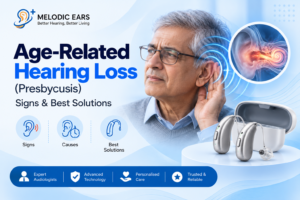
Age-related hearing loss, medically termed presbycusis, is the gradual, permanent decline in hearing sensitivity that occurs as people age. It affects both ears equally and develops slowly over years. The condition primarily impairs the ability to hear high-pitched sounds and understand speech in loud environments. While damage to inner ear hair cells cannot be medically reversed, prescription digital hearing aids, assistive listening devices, and environmental adjustments manage the condition effectively.
What is Presbycusis?
Presbycusis is a form of sensorineural hearing loss caused by changes in the inner ear, auditory nerve, or central auditory processing pathways over time. Inside the cochlea, tiny sensory hair cells convert sound vibrations into electrical signals for the brain. As these hair cells wear down or die, they do not regenerate. Most individuals begin to notice changes after age 60, though structural wear can begin earlier.
Because the hair cells at the base of the cochlea register high-frequency sounds, these are typically the first to degrade. Low-frequency hearing often remains intact longer, which changes how sounds are perceived rather than simply reducing overall volume.
Early Signs of Age-Related Hearing Loss
Presbycusis develops gradually, so many people do not realize their hearing has changed until family members or coworkers point it out. Recognizing the signs early prevents prolonged communication strain.
- Difficulty understanding speech in noise: Group conversations, family gatherings, or crowded restaurants become hard to follow. Background noise masks the high-frequency cues needed to distinguish individual words.
- Sensation that people are mumbling: Because high-pitched consonant sounds such as s, f, th, sh, and p are lost first, speech sounds loud enough but muffled. A common observation is hearing that someone is speaking without understanding what was said.
- Increasing audio volume: Needing the television or phone speaker turned up to levels that other people find uncomfortably loud.
- Difficulty hearing higher-pitched voices: Voices of women and young children are often harder to hear and understand than deeper male voices.
- Tinnitus: Persistent ringing, buzzing, clicking, or hissing sounds in one or both ears often accompany sensorineural hearing loss.
- Listening fatigue: Concentrating hard to follow everyday conversations requires extra mental effort, leaving people tired or irritable after social interactions.
Common Causes and Risk Factors
Aging is the primary driver of presbycusis, but multiple variables influence how quickly and severely the condition develops:
- Genetics: Family history plays a role in how early auditory hair cells degrade.
- Cumulative noise exposure: Decades of exposure to workplace noise, traffic, loud music, or machinery accelerate inner-ear cell damage.
- Cardiovascular conditions: The inner ear requires a steady blood supply to function. Hypertension, heart disease, and high cholesterol can restrict blood flow to the cochlea.
- Diabetes: Research indicates that people with diabetes experience hearing loss at higher rates due to nerve and blood vessel damage in the auditory system.
- Ototoxic medications: Certain high-dose nonsteroidal anti-inflammatory drugs, specific antibiotics (like aminoglycosides), and chemotherapy agents can damage sensory structures in the ear.
Also Read- Conductive Hearing Loss – What It Is & How Hearing Aids Help
How Presbycusis is Diagnosed
An accurate diagnosis requires an evaluation by an audiologist or an Ear, Nose, and Throat (ENT) specialist. An assessment typically includes several standard tests:
- Otoscopy: Visual examination of the ear canal and eardrum to rule out physical blockages such as earwax buildup, fluid, or structural damage.
- Pure-Tone Audiometry: The patient listens to tones across various pitches (frequencies) and volumes (decibels) through headphones. The results are plotted on an audiogram, which illustrates the quietest sounds heard at each frequency. A downward slope toward the right of the graph indicates high-frequency hearing loss typical of presbycusis.
- Speech Audiometry: Measures word recognition ability in quiet settings and against background noise to see how well the brain processes spoken language.
Best Solutions for Age-Related Hearing Loss
Sensorineural hearing loss cannot be cured through medication or standard surgical procedures. However, several clinical and practical options restore communication ability.
1. Digital Hearing Aids
Modern digital hearing aids are the primary treatment for mild to severe presbycusis. Rather than simply making all sounds louder, digital hearing aids selectively amplify the specific frequencies where hearing has declined while leaving normal-hearing frequencies balanced.
Common styles include:
- Receiver-In-Canal (RIC): The speaker sits inside the ear canal while the main body rests behind the ear. This open-fit style leaves the ear canal partially open, preserving natural low-frequency hearing while boosting high frequencies.
- Behind-The-Ear (BTE): Houses all components behind the ear, connected to an ear mould. Useful for moderate to profound losses and often easier to handle for individuals with reduced manual dexterity.
- In-The-Canal (ITC) and Completely-In-Canal (CIC): Custom-moulded devices that sit partly or fully inside the ear canal. They are discreet, though smaller batteries require more finger dexterity to change.
Current devices include features such as directional microphones, noise suppression algorithms, rechargeability, and Bluetooth connectivity for direct streaming from mobile phones and televisions.
Also Read- 10 Types of Hearing Aids Explained: Which One is Right for You?
2. Assistive Listening Devices (ALDs)
Assistive devices work alongside hearing aids or independently in specific situations:
- TV Streamers: Transmit television audio directly into compatible hearing aids, allowing the user to set their own volume without altering the sound for others in the room.
- Remote Microphones: Small clip-on microphones worn by a conversation partner that send speech straight to the listener’s hearing aids, bypassing distance and ambient room noise.
- Amplified Telephones: Phones with higher volume thresholds and frequency adjustments designed for landline users.
3. Cochlear Implants
When age-related hearing loss reaches a severe-to-profound stage where conventional hearing aids no longer provide adequate speech clarity, an ENT specialist may evaluate the patient for a cochlear implant. A cochlear implant bypasses damaged cochlear hair cells entirely and stimulates the auditory nerve directly using electrical pulses.
4. Communication and Environmental Strategies
Simple practical adjustments make conversations substantially easier for individuals with presbycusis:
- Face the speaker directly and maintain good lighting to allow lip-reading and facial cues.
- Ask conversation partners to speak clearly at a natural pace rather than shouting, which distorts words.
- Reduce background noise by turning off television sets or moving away from busy kitchen areas during conversations.
- Choose quieter tables away from the kitchen or loudspeakers when dining at restaurants.
Hearing Aid Price Ranges in India
The cost of hearing aids in India depends on the technology level, sound processing capabilities, channel count, and brand (such as Signia, Phonak, Widex, Oticon, or ReSound). Pricing is usually quoted per ear.
| Technology Tier | Approximate Price Range (Per Device) | Features Included |
|---|---|---|
| Basic Digital | ₹18,500 – ₹35,000 | Basic amplification, manual volume controls, limited noise reduction, battery-operated. |
| Standard / Mid-Range | ₹40,000 – ₹95,000 | Directional microphones, automatic environmental adaptation, feedback cancellation, select Bluetooth streaming options. |
| Advanced / Premium | ₹1,00,000 – ₹3,50,000+ | Advanced background noise filtering, hands-free Bluetooth calling, rechargeable options, motion sensors, smartphone app controls. |
Hearing aid pricing typically covers the physical device, initial programming, follow-up fine-tuning sessions, and manufacturer warranties, which usually span one to four years. Always clarify what aftercare services are included with the dispenser.
Frequently Asked Questions
Can presbycusis be cured or reversed?
Presbycusis cannot be reversed or cured. It involves permanent structural damage to the sensory hair cells of the inner ear. However, hearing aids and assistive devices help compensate for this loss by amplifying missing sound frequencies and clarifying speech.
Does age-related hearing loss affect both ears equally?
Yes. Presbycusis is typically symmetrical, meaning it develops at a similar rate and degree in both ears. If hearing loss occurs suddenly or affects only one ear, consult an ENT doctor promptly, as this suggests a different underlying medical issue.
Why can I hear people talking but not understand what they are saying?
Presbycusis primarily affects high-frequency sounds. Vowels (such as a, o, and u) are low-frequency sounds that carry volume, while consonants (such as s, t, and f) are high-frequency sounds that provide clarity. When high-frequency hearing declines, you hear the volume of vowels without the clarity of consonants, making speech sound muffled.
Does wearing a hearing aid make natural hearing worse over time?
Properly programmed hearing aids do not damage your hearing. They are calibrated to individual audiogram results so sounds never reach unsafe levels. Untreated hearing loss, on the other hand, can cause auditory deprivation, where the brain gradually loses its ability to interpret speech sounds from lack of stimulation.
When should someone see an audiologist for a test?
Anyone over age 50 who notices changes in conversation clarity, struggles in noisy places, experiences persistent ringing in the ears, or regularly needs higher media volume should schedule a pure-tone audiometry test. Routine screenings every two to three years help identify changes before they affect everyday communication.
Next Steps for Better Hearing
If you or an older family member notice signs of hearing difficulty, the practical first step is booking a diagnostic pure-tone audiometry test with a registered audiologist. A proper evaluation determines the exact degree of hearing loss and identifies the most suitable management option for your daily listening needs.